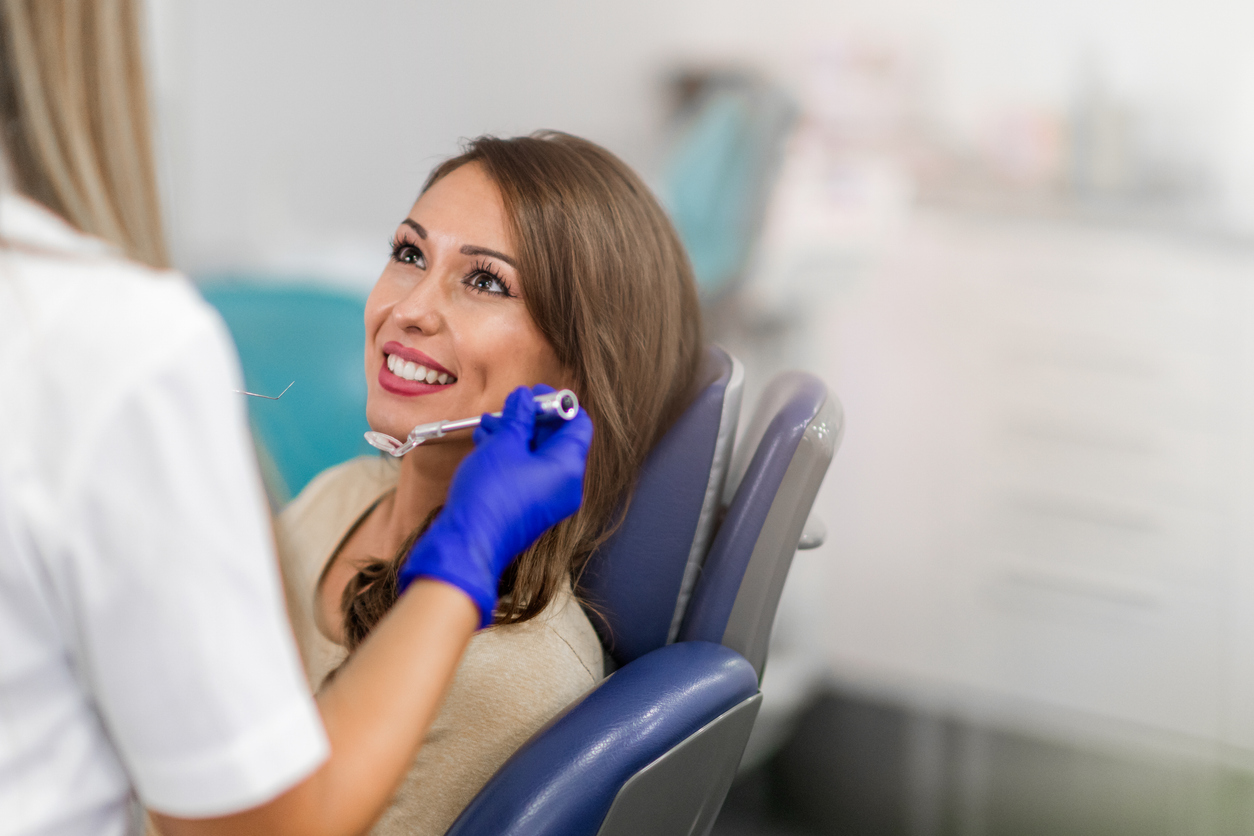
Most of a cosmetic case gets discussed in the operatory. Shape, length, how much tooth shows when the lips part, what the smile should look like in photographs. Those conversations happen face to face, and they leave the impression that the result is made entirely by the person holding the handpiece. It is not. Between the preparation appointment and the delivery appointment, a dental technician called a ceramist builds the restoration by hand, and that technician decides how the finished teeth will catch light. Patients rarely learn the name. Work ordered by a cosmetic dentist Encino CA residents visit is a collaboration between two people, only one of whom the patient ever meets. What follows explains what the ceramist contributes, what a cosmetic dentist Encino CA has to supply for that contribution to land, and why the working relationship between the two shows plainly in the finished teeth. A cosmetic dentist Encino CA does not produce that result alone.
The Person a Patient Never Meets Behind Work From a Cosmetic Dentist Encino CA
A dental laboratory is a workshop, not the factory floor patients often imagine. Technicians take responsibility for individual cases. One technician usually carries anterior ceramic work from start to finish. The technician receives models, photographs, written instructions, and a prescription. They then build teeth from powder and liquid over several days. Patients never enter the room and may not know it exists. When a cosmetic dentist Encino CA sends out a case, the laboratory receives information about a mouth the technician cannot examine. The final restoration depends on how well that information describes the mouth. Skilled ceramists develop reputations just as skilled clinicians do. Dentists often follow them from one laboratory to another. Patients judge the result in the mirror. In effect, they evaluate a technician’s hand without knowing the technician exists.
What a Ceramist Actually Does to Build a Restoration for a Cosmetic Dentist Encino CA
The work starts with a model of the prepared teeth. The laboratory may pour the model in stone or print it from a digital scan. The technician trims the model, marks the margins, and mounts it against the opposing arch. This lets the technician reproduce the bite outside the mouth. The technician mixes ceramic powder and liquid into a paste. They apply it with a fine brush, layer by layer, to the prepared surface. Each furnace firing shrinks the ceramic. The technician therefore overbuilds it and rebuilds it after each firing. They cut back the shape with rotary instruments and refine it under magnification. A case from a cosmetic dentist Encino CA may go through the furnace five or six times. Nothing in this hand-built workflow is automated. The final tooth reflects many decisions about thickness, opacity, texture, and edge translucency.
Pressed to a Shape Versus Layered by Hand in a Cosmetic Dentist Encino CA Case
Two broad methods produce a ceramic restoration. In the first, the technician makes and invests a wax pattern. Heat and pressure then force ceramic into the mold. This creates a unit with uniform material throughout. In the second method, the technician builds the restoration with separate powders. They place opaque material where dentin would be and translucent material where enamel would be. Pressed work is stronger and more consistent from unit to unit. Layered work can imitate a natural tooth’s internal structure because the technician creates that structure. A cosmetic dentist Encino CA chooses the method case by case. The dentist may also press a core and layer only the facial surface. The choice is not about quality in the abstract. It depends on the needed optical complexity and the force the restoration must withstand.
Why Shade Is Information Rather Than a Number for a Cosmetic Dentist Encino CA
A prescription’s shade designation describes only one quality of a tooth. It roughly identifies hue and saturation at one point. Natural teeth do not have one color. They are lighter and more opaque at the gumline. They become more saturated through the middle. At the biting edge, they are often more translucent and grayer. Teeth can also show white flecks, faint horizontal lines, and areas where dentin shows through. A shade tab records none of those details. When a cosmetic dentist Encino CA sends only a number, the technician must invent the missing information. That invention may not match adjacent teeth. A useful prescription explains distribution. It identifies the brightest areas, translucency, and any craze lines in neighboring teeth. Shade is a written description of a surface for someone who will never see it in person.
Photographs, Reference Tabs, and What a Cosmetic Dentist Encino CA Sends to the Laboratory
Photographs close much of the gap left by a written note. The standard approach places a shade tab beside the tooth being matched. Both should sit in the same plane and light. This gives the technician a known reference in the image. Without a tab, lighting and processing alter the recorded color. The technician cannot correct for that change. With a tab, the tooth-to-tab relationship remains reliable even if the full image shifts. The dentist usually takes several images. One faces straight on. Another shows edge translucency at an angle. A third uses off-axis flash to reveal surface texture. A cosmetic dentist Encino CA who photographs carefully gives the ceramist the actual pattern of light across nearby teeth. Poor photographs often cause a case to return for a second attempt.
The Stump Shade and Why a Cosmetic Dentist Encino CA Records the Prepared Tooth
Thin ceramic is partly translucent. As a result, the tooth color underneath affects the final appearance. A prepared tooth is not a neutral background. It may remain close to its original color. An old restoration may darken it. Root canal treatment may gray it. Fresh dentin may make it brighter after reduction. The technician needs this information. A veneer made for a light preparation can look dull and lifeless over a dark tooth. The dentist records the prepared tooth shade immediately after preparation, before dehydration lightens it. The dentist also photographs it against a reference tab. A cosmetic dentist Encino CA who skips this step leaves the laboratory guessing about a major variable. For a dark preparation, the technician adds opacity. That adjustment can reduce the depth the restoration might otherwise show.
Why a Single Central Incisor Is the Hardest Request a Cosmetic Dentist Encino CA Can Send
When both front teeth need restoration, the technician controls both teeth and can build symmetry. Restoring one tooth beside an untouched neighbor presents a different challenge. The technician must reproduce a tooth that already exists, including its individual irregularities. The natural tooth has its own translucency pattern, surface texture, slight rotation, worn edge, and faint stains. The technician must reproduce all of it in ceramic. The ceramic must then appear identical in daylight, office lighting, and phone-camera images. Most laboratories consider this their most demanding work. A cosmetic dentist Encino CA who orders a single central incisor usually sends more photographs and detailed notes. Sometimes the patient visits the laboratory. The margin for error is measured in details a patient will notice every morning. Even an excellent result often requires at least one revision.
Characterization and the Small Irregularities a Cosmetic Dentist Encino CA Looks For
A tooth made in a perfect form looks wrong. Natural enamel has horizontal ripples on the facial surface. It also has vertical grooves, a slightly uneven incisal line, and small opaque developmental spots. The biting edge is often thinner and bluer than the body. It may also have a thin bright halo. Teeth that have spent decades in the mouth show flattened contact areas and small chips. Technicians call the deliberate reproduction of these details characterization. It helps a restoration disappear among neighboring teeth instead of looking manufactured. A cosmetic dentist Encino CA requests characterization that suits the patient’s age and surrounding teeth. A twenty-year-old and a sixty-year-old do not show the same surface. Too little detail can make a tooth look printed. Too much can look like an obvious attempt at naturalness.
The Custom Staining Pass and How Far It Can Go for a Cosmetic Dentist Encino CA
Surface stains are thin colored ceramics that technicians apply over a finished restoration. They fire the stains at a lower temperature. Stains can add orange inside a groove, gray at the edge, a white spot, or a faint enamel-crack line. Used well, they add details that layering did not create. Used heavily, they remain on the surface and look like paint. Natural tooth color has depth behind it. Surface staining also wears. A restoration that relies heavily on stain loses character sooner than one with color built internally. A cosmetic dentist Encino CA uses staining as a finishing adjustment, not a replacement for layering. It is also the easiest detail to change at delivery. That makes it useful for small corrections when a restoration is close but not fully settled.
The Try In Appointment Where a Cosmetic Dentist Encino CA Brings Patient and Ceramist Together
Some laboratories send a technician to the office or receive the patient directly. The restoration is tried in before final glazing. The technician sees the work beside real teeth, under real light, and within the patient’s face. This can replace two or three mailed adjustment cycles with one afternoon. The arrangement is uncommon because it costs the laboratory a working day. Laboratories usually reserve it for single anterior units or cases with earlier mismatches. When available, it removes a major source of error. The technician can work from the mouth rather than from a representation. A cosmetic dentist Encino CA with a nearby laboratory relationship can sometimes arrange this visit. Patients who meet the ceramist often better understand how the work is made.
What a Cosmetic Dentist Encino CA Must Supply for the Ceramist to Succeed
The finest technician cannot correct a poor preparation. Margins have to be smooth, continuous, and placed where the technician can locate them, because an indistinct margin is an invitation to guess where the restoration ends. Reduction has to be sufficient and even, since ceramic thinner than its minimum will fracture and ceramic made too thick has to be bulked into a shape that does not fit the face. The impression or scan has to capture the margin without distortion, and the bite record has to reproduce how the teeth actually meet. Beyond mechanics, the case needs a stated goal. A technician told only to match the adjacent teeth will match them, including the features the patient wanted changed. A cosmetic dentist Encino CA who writes down what the restoration is meant to achieve, and what the patient objected to in the current appearance, arrives much closer on the first attempt.
The Chairside Workflow and Where a Cosmetic Dentist Encino CA Fits Each Approach
A chairside system scans the prepared tooth, designs the restoration on screen, and mills it from a ceramic block in the office, usually within the same visit. Nothing is mailed and nothing is waxed. The restoration is monolithic, meaning one uniform material, and it is finished with surface stain and glaze rather than layered powders. For posterior crowns, onlays, and many single units where the demand is function plus a convincing rather than extraordinary appearance, this approach is efficient and removes the temporary phase entirely. For a thin anterior veneer that has to sit beside an untouched natural central incisor, hand layering still reaches a ceiling the block does not. An office running both can route each case to the workflow that suits it. A cosmetic dentist Encino CA with only one option available fits every case to that option, which is a different kind of decision and worth understanding before treatment begins.
How a Practice Chooses a Laboratory and What a Cosmetic Dentist Encino CA Gains From Consistency
Laboratories are chosen by trial, and the trial takes years. A dentist sends cases, examines what comes back, notices whether the technician reads instructions carefully or defaults to habit, and watches how the laboratory handles work that has to be remade. The important variable is not the best case a laboratory has ever produced but the ordinary case it produces reliably. Over time, a dentist and a technician develop a shorthand. The technician learns how that particular dentist prepares teeth, how that dentist photographs, what a given note tends to mean. The dentist learns what the technician needs and what can go unsaid. That accumulated understanding explains why a cosmetic dentist Encino CA rarely changes laboratories casually, and why a change of technician inside the same laboratory can appear in the work before anyone mentions it. Consistency is the quality patients notice least and benefit from most, since it turns a good outcome into the expected one.
What Patients Can Ask a Cosmetic Dentist Encino CA About Who Makes Their Restorations
Patients are entitled to ask where their restorations are being made and by whom. Reasonable questions include whether the work is milled in the office or sent to a laboratory, whether the restoration will be pressed or layered by hand, whether the same technician handles the practice’s anterior cases, and whether photographs will be taken for shade communication. Asking whether a try in appointment is possible is fair as well, particularly for a single front tooth. None of these questions are adversarial, and most dentists answer them readily, since the answers explain both the timeline and the planning. A cosmetic dentist Encino CA able to describe the laboratory relationship in specific terms is describing something that genuinely affects the outcome. A patient who grasps that a person is building the restoration by hand also understands why a remake is sometimes the right answer and why the schedule is not entirely within the office’s control.
Why Patients Choose August de Oliveira DDS as a Cosmetic Dentist Encino CA
August de Oliveira DDS practices at 5400 Balboa Blvd #231, Encino, CA 91316, with hours Monday through Thursday from 8 to 5 and Friday by appointment. Dr. de Oliveira’s focus is digital dentistry, and the office runs both chairside CEREC and full laboratory workflows. That combination bears directly on the subject of this article, because it means a case is not forced into a single production method. A posterior crown that benefits from being milled and delivered in one visit can be handled that way, and an anterior case that needs a technician’s hand can be sent out with the records a technician requires. Patients travel to the practice from Encino, Sherman Oaks, Van Nuys, Tarzana, Calabasas, Woodland Hills, Studio City, and Reseda. A cosmetic dentist Encino CA patients return to across years is usually one whose planning stays visible, and the laboratory question belongs to that planning rather than to the background.
Final Thoughts on Choosing a Cosmetic Dentist Encino CA
Much of what makes a restored front tooth convincing was decided by someone the patient never met, working from photographs, a model, and a set of written notes. The ceramist supplies the craft. The dentist supplies the preparation, the records, and the description of what the result has to accomplish. Neither part succeeds without the other, which is why the relationship between a practice and its laboratory shows up in finished work more plainly than any single material or technique does. Patients considering cosmetic treatment are generally well served by asking how that relationship operates. This article is general information about how cosmetic restorations are made and is not a treatment recommendation for any individual; a cosmetic dentist Encino CA can evaluate a specific mouth and explain what a particular case would require. Patients who would like to discuss cosmetic treatment are invited to contact the office of August de Oliveira DDS to schedule a consultation.