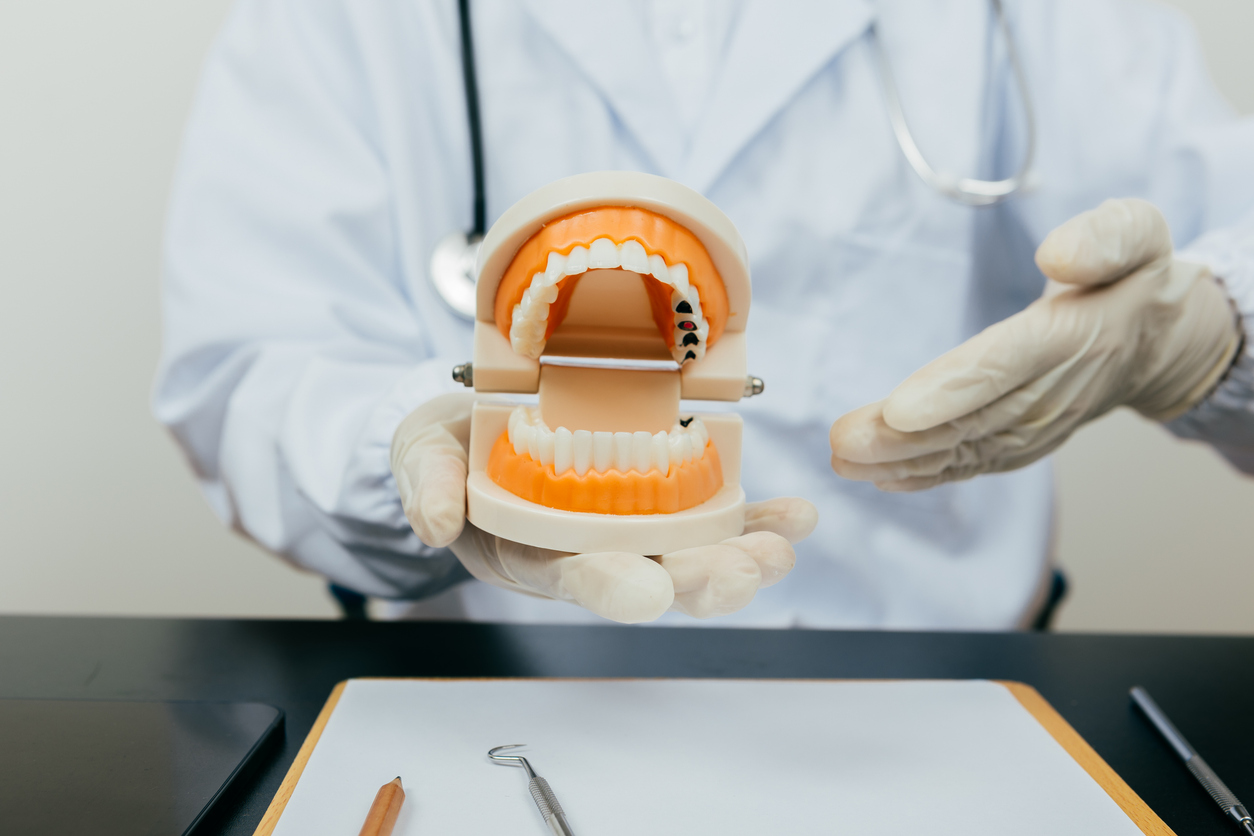
Most writing about full arch implant treatment stops at surgery and resumes when the final teeth arrive. The months between are not blank. Full mouth dental implants involve ordinary life with a provisional restoration in place. Patients often want to know what dinner looks like, whether colleagues notice, and when speech feels normal again. Clinical articles often skip this period because little dramatic happens. Patients do not skip it because they live through it. This article covers the middle of treatment: eating, speaking, working, sleeping, cleaning, traveling, and adjusting.
Why the Middle Months of a Full Mouth Dental Implants Procedure Are Rarely Described
Published material tends to follow the clinician’s attention, and the clinician’s attention concentrates where decisions are made. Surgery is a decision. Final design is a decision. The interval between them is mostly biology proceeding on its own schedule, which makes for a short paragraph in a clinical summary and a long season in a patient’s life. The imbalance is understandable and still unhelpful, because a patient preparing for treatment is trying to picture a calendar, not a flowchart.
The interim is also hard to generalize. Healing varies with the number of teeth removed, the bone response, the provisional design, and the way each person chews and talks. This stage of full mouth dental implants calls for tendencies, not guarantees. Still, saying nothing leaves patients to guess.
What the Provisional Prosthesis in a Full Mouth Dental Implants Procedure Is and Is Not
A provisional prosthesis is a working set of teeth attached to implants or healing components while integration proceeds. It restores appearance and supports the lips and cheeks. It also lets speech reorganize and allows a restricted range of foods. The provisional provides useful information about tooth position, bite, and hygiene access before the final prosthesis is made.
The provisional is not the final restoration. That is intentional, not a compromise. The team selects materials that are adjustable and repairable rather than maximally hard. Chairside changes can protect healing implants from forces that still need refinement. Flexibility takes priority over surface texture, shade depth, and strength. Understanding this helps patients judge a provisional by its intended role.
The First Days at Home After the Surgical Stage of a Full Mouth Dental Implants Procedure
The first days are quieter than most patients expect and busier than they planned for. Swelling and tenderness build before they recede, speech sounds unfamiliar, and the simple work of getting through a day takes more energy than usual. Most people arrange for someone else to drive, clear the calendar for a stretch, and keep soft food and cold drinks stocked and within reach rather than improvising meals while tired.
Specific aftercare belongs with the office that performed the surgery, and this article does not substitute for it. Every surgical team issues written post-operative instructions covering rinsing, diet, activity, swelling management, and when to call, written for the case in front of them. Patients in the early days of a Full Mouth Dental Implants Procedure should follow that sheet exactly, keep it somewhere visible rather than filed away, and call the office with questions instead of searching for general answers online.
Returning to Ordinary Food During a Full Mouth Dental Implants Procedure, One Texture at a Time
Appetite usually returns before the mouth is ready for what the appetite wants, and this mismatch is the source of most interim frustration. The progression back toward ordinary eating is governed by texture rather than hunger. Soft foods that need no cutting come first. Then foods that yield under light pressure. Then foods requiring a deliberate bite but not a tearing motion. Hard, crusty, sticky, and stringy foods stay off the list the longest, not because they are forbidden in principle but because they generate exactly the forces that healing implants should be spared.
Patients often find the practical adjustments more interesting than the restrictions. Cutting food smaller, chewing toward the back rather than biting with the front teeth, and working both sides evenly become habits within a week or two. Through much of a Full Mouth Dental Implants Procedure the front of a provisional serves appearance and speech more than biting, and shifting that load rearward stops feeling like a rule and starts feeling like technique.
Speech Adaptation in the Early Weeks of a Full Mouth Dental Implants Procedure
The tongue is a precise instrument that has spent decades learning the exact interior shape of a particular mouth. A provisional changes that shape, and the tongue needs time to remap it. The sounds that shift first are made against the back of the upper front teeth and the palate: s, sh, th, f, and v are the usual offenders. A slight whistle on s or a thickness on th is common early and is not a sign that anything was built incorrectly.
Adaptation responds to practice more reliably than to waiting. Reading aloud for a few minutes a day, taking phone calls rather than avoiding them, and speaking a little more slowly all accelerate the process. Most patients partway through a Full Mouth Dental Implants Procedure report that speech normalizes sooner than expected, and that other people stopped noticing long before they did. Persistent trouble with a specific sound is worth mentioning at the next visit, since contour adjustments can resolve it.
The Sore Spot and the Adjustment Visit During a Full Mouth Dental Implants Procedure
A sore spot during healing is ordinary. Tissue shrinks and reshapes as swelling resolves, bone remodels under the prosthesis, and a surface that seated comfortably in week one can press on a ridge in week four. The result is a small, specific, persistent tender area, usually identifiable by the patient to within a few millimeters. It is a mechanical problem with a mechanical solution, and the solution is a short appointment.
Adjustment visits are planned into a Full Mouth Dental Implants Procedure rather than treated as complications. The office relieves the pressure point, refines the bite if contacts have changed, polishes the adjusted surface, and the patient leaves. What matters is not waiting them out. A sore area endured for weeks can become an irritated area that takes longer to settle, and a bite that has drifted loads some implants more than others. Reporting a problem early keeps the fix small, which is the reason the office schedules check-ins through the healing interval.
Cleaning a Provisional Prosthesis Through the Healing Phase of a Full Mouth Dental Implants Procedure
Hygiene during the interim is not a holding action until the real teeth arrive. The tissue healing around the implants and the components passing through it are the foundation the final prosthesis will sit on, and inflammation in that tissue is the one interim problem capable of affecting the long term outcome. Keeping the area clean during healing is therefore part of the treatment rather than an adjacent chore.
The practical difficulty is that a provisional is cleaned differently from natural teeth. The surfaces that matter most are underneath, where the prosthesis meets tissue, and reaching them calls for tools a patient may never have used: threader floss, interdental brushes sized to the spaces, and often a water flosser aimed along the junction. The office demonstrates the routine and shows which spaces need which tool. Patients several weeks into a Full Mouth Dental Implants Procedure usually find it takes a few minutes once familiar, and that building the habit early makes maintaining the final prosthesis straightforward later.
Sleeping, Grinding, and Night Protection During a Full Mouth Dental Implants Procedure
Sleep is unsettled for the first stretch and then generally improves. Early on, propping the head higher than usual is a common comfort measure. Beyond that, the main nighttime question is grinding and clenching, which many adults do without knowing it and which can continue through healing regardless of what the mouth now contains.
Nighttime force matters here more than it does with natural teeth. A natural tooth sits in a ligament that cushions and signals; an implant integrated into bone does neither, so parafunctional load transfers more directly to the prosthesis and its supporting components. Offices often respond by having a patient wear a night appliance over the provisional, by adjusting the bite so forces distribute evenly, or both. Whether anything is worn at night during a Full Mouth Dental Implants Procedure is decided case by case, and patients who know they grind should say so at the planning stage rather than after a provisional has chipped.
Working and Appearing in Public in the Middle of a Full Mouth Dental Implants Procedure
Most patients return to desk work within days and to physically demanding work somewhat later, with timing set by the surgical team rather than by a general rule. The more common question is not when work resumes but how visible the situation is. In practice, a well designed provisional looks like teeth. It is built to the planned tooth position, with reasonable shape and shade, and ordinary conversation at ordinary distance does not reveal it.
What patients tend to notice about themselves is not appearance but the small accommodations: a slower pace of speech, a preference for coffee over a pastry, a tendency to let someone else talk during the first week back. Those accommodations fade. Working through a Full Mouth Dental Implants Procedure is an exercise in managing a short list of logistics, not in hiding. Patients who speak publicly for a living often schedule an extra week of adaptation before a significant presentation, which is a reasonable use of the interval.
Restaurants and Social Eating Partway Through a Full Mouth Dental Implants Procedure
Social eating is the part of the interim that patients most often describe as isolating, and it responds well to planning. The constraint is texture, not quantity, so most menus contain workable options once a patient knows what to look for. Braised and slow cooked dishes, eggs, fish, soups, pasta, and soft grains generally work. Steak, crusty bread, raw vegetables, nuts, and anything requiring a front tooth tear generally do not, at least for a while.
The strategies patients adopt are unremarkable and effective: scanning the menu before arriving, ordering something cuttable, asking for an item prepared softer, cutting food smaller than usual, and chewing toward the back. Many simply tell close friends what is going on and stop managing the question entirely. Declining a dinner invitation during a Full Mouth Dental Implants Procedure is rarely necessary; choosing differently once seated almost always is. The restrictions are temporary, and the social habit is easier to keep than to restart months later.
Exercise and Ordinary Activity as a Full Mouth Dental Implants Procedure Heals
Activity returns in stages, and the staging comes from the surgical team. Early on, exertion that raises blood pressure sharply is usually limited, since it can aggravate swelling and bleeding at the surgical sites. Walking is typically the first thing resumed. Light cardiovascular work tends to follow, then resistance training, then contact or impact activity, with the specific timing on the office’s written instructions rather than in an article.
Two considerations persist after the early restrictions lift. One is impact: any activity with a real chance of a blow to the face warrants protection and a conversation with the office, because a provisional is not built to absorb that. The other is clenching, common during heavy lifting, which loads the prosthesis in exactly the way healing implants should avoid. Patients who train seriously through a Full Mouth Dental Implants Procedure often moderate loads for a season or wear a protective appliance while lifting.
Travel and Calendar Planning Around a Full Mouth Dental Implants Procedure
Travel is possible through most of the interim, and the limiting factor is the appointment calendar rather than the act of traveling. Healing requires periodic check-ins, adjustments arise unpredictably, and the conversion to the final prosthesis involves a sequence of visits that cannot be compressed much. Planning a long trip without mapping it against that schedule is how patients end up extending the interim by weeks.
The practical approach is to raise travel plans at the start. Offices can often cluster appointments before a departure or hold a window open after a return. Patients traveling during a Full Mouth Dental Implants Procedure usually pack their hygiene tools rather than planning to buy them and keep the office’s contact information accessible. Time zones and long flights are not themselves a concern. Being far from the treating office for an extended stretch during an active phase is, which is a scheduling problem and easily solved in advance.
The Conversion Appointment That Ends the Interim Stage of a Full Mouth Dental Implants Procedure
At some point the implants have integrated, the tissue has settled into a stable contour, and the office confirms the foundation has stopped changing. Records are taken again, the final prosthesis is designed and fabricated using everything the provisional revealed, and a date is set to exchange one for the other. That appointment is the end of the interim.
What changes that day is more than appearance. The final prosthesis is made in a harder, more polished, more color stable material, which changes how it feels against the tongue and how it handles food. The bite is refined with the expectation that it will stay refined. Many patients are surprised by how different the surface texture feels and by how quickly that novelty passes. Ending the provisional stage of a Full Mouth Dental Implants Procedure also changes the diet conversation, since the restrictions that protected integration are reconsidered. Hygiene, by contrast, does not relax. The routine built during healing is the routine that maintains the result.
Staying in Contact With the Office Through the Quiet Months of a Full Mouth Dental Implants Procedure
The interim is quiet by design, and quiet periods are where communication tends to lapse. A patient feeling reasonably well may skip a check-in, tolerate a minor rub, or wait three weeks to mention that a sound still comes out wrong. None of those are serious individually. Collectively they are how small, correctable issues become larger ones, and how a final prosthesis inherits a problem the provisional had already identified.
Offices schedule periodic visits through this stretch for exactly that reason. The visits confirm healing, catch bite changes, review hygiene technique, and give a patient a predictable moment to raise anything that has come up. Between visits, calling about something minor is appropriate rather than excessive. Most of what happens in the middle of a Full Mouth Dental Implants Procedure is invisible to the patient and visible to the office, and the exchange runs the other direction too. The office cannot adjust for a complaint nobody reported, and the provisional exists partly to collect those reports.
Why Patients Choose August de Oliveira DDS for a Full Mouth Dental Implants Procedure
August de Oliveira DDS practices at 5400 Balboa Blvd #231, Encino, CA 91316, with office hours Monday through Thursday from 8 to 5 and Friday by appointment. The practice serves patients from Encino, Sherman Oaks, Van Nuys, Tarzana, Calabasas, Woodland Hills, Studio City, and Reseda.
Dr. de Oliveira’s focus is digital dentistry, and the office runs both chairside CEREC and full laboratory workflows. That combination matters during the interim specifically. Chairside capability means certain adjustments and repairs can be handled during a visit rather than scheduled around a shipment, shortening the gap between a patient noticing a problem and the problem being resolved. Laboratory workflows carry the complex fabrication a full arch case requires. For a Full Mouth Dental Implants Procedure, having both lets the office choose the path that fits the situation instead of fitting the situation to one process. Digital records also make the provisional useful as a diagnostic object, since what it reveals over months carries precisely into the final design.
Final Thoughts on the Full Mouth Dental Implants Procedure
The months between surgery and the final teeth are the least described and most lived part of this treatment. They are also, in most cases, unremarkable in the best sense: a period of gradual adjustment during which eating widens, speech settles, routines form, and the mouth does its work quietly. Knowing what the stretch involves beforehand, rather than discovering it in week two, separates patients who find the interim manageable from those who find it surprising. A Full Mouth Dental Implants Procedure asks for patience during a phase where nothing visible happens, and patience is easier to supply when the phase has been described honestly.
This article is general information and not medical advice. Every case differs, and only an examination with records can determine what a patient needs or how long any phase will take.
Patients in Encino and the surrounding communities can contact August de Oliveira DDS at 5400 Balboa Blvd #231, Encino, CA 91316 to schedule a consultation.