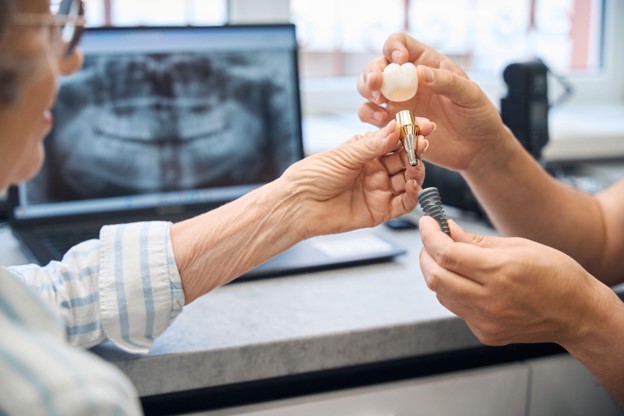
Losing a tooth is usually described as a cosmetic problem or a chewing problem. The more consequential change happens under the gum, where the bone that held the root begins to shrink the moment the root is gone. That bone, called alveolar bone, is not permanent skeletal architecture. It is tooth-dependent tissue, and it behaves accordingly. Patients who ask about Dental Implants Encino are usually thinking about the visible gap, while the decision in front of them is about how much jawbone they intend to keep. What follows covers the biology of ridge resorption, what a bridge or a denture does and does not do about it, and why Dental Implants Encino is the only replacement that puts working load back into bone. It also covers the imaging, grafting, and timing decisions that determine whether Dental Implants Encino stays a straightforward procedure or becomes a staged reconstruction.
Alveolar Bone Exists to Serve Teeth, and Dental Implants Encino Works With That Rule
The jaw is not one uniform block. The basal bone of the mandible and maxilla is structural skeleton; it carries the shape of the face and stays whether teeth are there or not. On top of it sits the alveolar process, a specialized envelope of bone that forms only because a tooth erupted into it and recedes when the tooth leaves. Its inner lining, the bundle bone, is the anchorage for periodontal ligament fibers. When the root is extracted those fibers are gone, the bundle bone loses its reason to exist, and osteoclasts begin removing it within days. That single fact reframes the conversation about Dental Implants Encino. The question is not how to fill a gap in the smile; it is what will keep a piece of tooth-dependent anatomy from quietly disassembling itself.
The Resorption Timeline After Extraction and What Dental Implants Encino Interrupts
Ridge loss is not gradual and even. It is front-loaded. The socket fills with clot and then woven bone while the outer walls collapse inward, and most of the dimensional change occurs in the first six to twelve months. Width is lost faster than height, and width is what a fixture needs on both the cheek side and the tongue side. After that first year the curve flattens, but it never reaches zero. A ridge edentulous for a decade is measurably narrower and shorter than it was at extraction, and one that has carried a denture for thirty years can be reduced to a knife edge. Planning Dental Implants Encino early takes advantage of the widest, tallest version of the ridge a patient will ever have again.
The Thin Buccal Plate Goes First, Which Is Why Dental Implants Encino Timing Matters
In cross section, an upper front tooth socket is asymmetric. The palatal wall is thick and well supplied with marrow, while the buccal wall, the one facing the lip, is often less than a millimeter thick and in many people is composed almost entirely of bundle bone. Bundle bone is the tissue with no purpose after extraction, so the facial wall of a healed socket sinks in first, producing the shadowed dimple patients notice above a bridge pontic years later. Once the buccal plate is gone the ridge sits palatal to where the tooth stood, and restoring correct emergence with Dental Implants Encino requires either grafting the deficit back or angling the restoration in a way that compromises the profile. That wall is far easier to protect while it still stands.
A Bridge Restores the Crown While the Bone Stays Idle, Unlike Dental Implants Encino
A three-unit bridge is a real restoration; it seals the gap, restores chewing, and can look excellent. What it cannot do is send force below the gumline. The load travels down the two prepared abutment teeth into their periodontal ligaments, and the pontic floats over the ridge. The bone under the pontic receives no functional signal, so it continues the resorption curve it started at extraction. Years later the tissue recedes away from the pontic, a dark triangle opens, and food packs underneath. The abutment teeth have also been reduced for crowns, a permanent trade. Dental Implants Encino avoids both problems by placing the load where the root used to be rather than beside it.
Removable Dentures Ride on the Ridge While Dental Implants Encino Anchors Inside It
A removable partial or complete denture is supported by soft tissue and the crest of the ridge, not by bone. Chewing force reaches the crest through mucosa as surface pressure rather than the tension and compression bone reads as a signal to stay. That pressure is associated with accelerated ridge reduction, which is why a denture wearer needs relines every few years; the appliance is not changing, the foundation under it is. Over decades a lower ridge can flatten until the mental nerve sits near the surface and the denture turns painful and unstable. Dental Implants Encino changes the mechanics entirely by moving support from the surface of the ridge into the interior of the bone, which is where load turns into preservation instead of abrasion.
Osseointegration Explained, the Biological Basis of Dental Implants Encino
Osseointegration is a direct structural and functional connection between living bone and a titanium fixture, with no fibrous tissue layer between them. Titanium and its alloys form a stable oxide layer that bone will bond to, and modern fixtures add a moderately roughened surface, typically blasted or acid-etched, that increases the area available for that bond. After placement, blood clots against the surface, osteoblasts migrate onto it, woven bone forms, and over roughly three to six months that bone remodels into load-bearing lamellar bone. The result is not a tooth in a ligament; it is metal locked into mineral. That rigid connection is what allows Dental Implants Encino to behave like a root rather than an appliance, and it is why healing time and initial stability are treated as non-negotiable parts of the plan.
How Functional Loading Transmits Force Into Bone With Dental Implants Encino
Bone is responsive tissue that maintains density where it is strained and removes itself where it is not. A natural root spreads chewing force through the periodontal ligament into surrounding alveolar bone, and that repeated strain is the maintenance signal. An integrated fixture does something similar by another route, transferring occlusal force through its threads into the bone it contacts, with the highest strain in the crestal few millimeters. That is why crestal bone level is the measurement a dentist watches on follow-up radiographs. When the restoration is in balanced occlusion and the patient is chewing normally, the bone around Dental Implants Encino tends to hold its level rather than continue to melt away. That preservation is local, limited to the bone the fixture engages, which argues for replacing teeth individually rather than letting a segment go untreated.
Facial Height, Lip Support, and Bite Drift After Years Without Dental Implants Encino
Ridge loss accumulates in ways patients read as aging rather than as dental change. Vertical loss in the anterior maxilla removes the scaffolding behind the upper lip, so the lip loses projection and rolls inward. In the lower jaw, decades of resorption reduce facial height, the chin rotates forward, and folds deepen at the corners of the mouth. The bite migrates as well. Teeth adjacent to an untreated space tip into it, and the opposing tooth supra-erupts out of its socket because nothing occludes against it. By the time a patient returns for Dental Implants Encino, that supra-erupted tooth may need occlusal reduction, orthodontic intrusion, or a crown of its own before there is enough vertical clearance to build a restoration in the space that was left open.
What a CBCT Scan Actually Measures Before Dental Implants Encino
A two-dimensional radiograph shows height and a rough bone level; it cannot show width, and width is what fails a case. Cone beam computed tomography produces a volumetric data set the dentist can slice in any plane, and the planning measurements are specific. Ridge height is measured from the crest to the nearest critical structure. Ridge width is measured at the crest and again several millimeters apical, since many ridges are broad at the base and narrow on top. In the posterior mandible the inferior alveolar nerve canal is traced and a safety margin preserved above it. In the posterior maxilla the sinus floor is mapped, since residual height there is often a few millimeters. Planning Dental Implants Encino from that data set means fixture diameter, length, and angle are decided before any incision is made.
Bone Density Zones and How They Change Dental Implants Encino Technique
Not all jawbone behaves the same under a drill. The anterior mandible is dense cortical bone with tight trabeculae; it grips a fixture firmly, gives high initial stability, and is unforgiving of overheating during preparation. The posterior maxilla sits at the opposite end, with a thin cortical shell over open, fatty marrow that offers far less mechanical grip. The posterior mandible and anterior maxilla fall between them. This is a practical distinction, not an academic one. In soft bone the surgeon may underprepare the osteotomy, use osteotomes to condense rather than cut, choose a wider or more aggressively threaded fixture, and allow longer healing before loading. Matching technique to density is one reason Dental Implants Encino is planned site by site instead of applied as one protocol to every region of every mouth.
Socket Preservation Grafting Is the Least Expensive Bone in Dental Implants Encino
The moment a tooth comes out is the one moment when preventing bone loss is nearly free. Socket preservation means the extraction is done atraumatically, ideally with periotomes rather than heavy elevation, the socket is debrided, particulate graft is placed to maintain the volume of the walls, and a membrane or collagen plug keeps soft tissue from collapsing inward. The graft does not create bone by itself; it holds the architecture while the body’s own healing fills it. Grafted sockets retain more ridge width and height than sockets left to heal open, which often means a straightforward placement a few months later instead of a staged reconstruction. Measured against the cost of later augmentation, the graft placed at extraction is the cheapest bone a patient pursuing Dental Implants Encino will ever buy.
Graft Material Categories in Plain Language for Dental Implants Encino
Four categories cover nearly everything used in the mouth. Autograft is the patient’s own bone, taken from the chin, the ramus, or collected during drilling; it carries living cells and remains the biological benchmark, at the cost of a second surgical site. Allograft is processed human donor bone from a tissue bank, supplied as mineralized or demineralized particles. Xenograft is a mineral scaffold derived from another species, most often bovine, treated until only the mineral lattice remains; it resorbs slowly, which makes it useful where long-term volume matters. Alloplast is fully synthetic, such as calcium phosphate ceramics or bioactive glass. Most grafting done for Dental Implants Encino uses one of these or a blend, selected by how quickly the material should turn over and how long it must hold space while native bone grows through it.
Ridge Augmentation and Sinus Lift Procedures When Dental Implants Encino Was Delayed
Patients who waited are not out of options; the options are simply larger. A narrow ridge can be widened with guided bone regeneration, layering particulate graft and a membrane against the deficient wall, or split and expanded, or rebuilt with a screw-fixed block graft. Vertical deficits are harder and may call for titanium-reinforced membranes or tenting screws to hold space against soft tissue. In the upper back jaw, where the sinus has pneumatized down into the ridge, a sinus lift elevates the Schneiderian membrane off the sinus floor and places graft beneath it, through a lateral window or through the osteotomy itself when only a few millimeters are needed. These procedures make Dental Implants Encino possible in sites that would otherwise be untreatable, though they add surgical stages, months of healing, and expense earlier action would have avoided.
Immediate Versus Delayed Placement and the Cost of Postponing Dental Implants Encino
Immediate placement puts the fixture into the fresh socket at the same appointment, shortening treatment time and letting the surgeon use the socket walls as a guide. It requires an intact buccal plate, no active purulent infection, and enough bone apical or palatal to the socket for primary stability, since a fixture that spins cannot integrate. Delayed placement waits for soft tissue closure or bony healing and is safer when the socket is compromised. Both are legitimate, and the choice is made on the anatomy in front of the dentist. What stays consistent is the direction of the trend. For every year a site goes unrestored, Dental Implants Encino tends to require more grafting, more appointments, longer healing, and a more compromised prosthetic result than the same case would have needed near the time of extraction.
Why Patients Choose August de Oliveira DDS for Dental Implants Encino
August de Oliveira DDS practices at 5400 Balboa Blvd #231, Encino, CA 91316, open Monday through Thursday from 8 to 5 and Friday by appointment. Dr. August de Oliveira’s focus is digital dentistry, which shapes how bone-driven cases are planned and delivered. Three-dimensional imaging, digital scanning, and restorative design run in one connected workflow, so fixture position is determined by where the final crown needs to sit rather than the other way around. The office runs both chairside CEREC and full laboratory workflows, so a single-unit restoration can often be designed and milled in house while larger reconstructions go to the lab with digital records already captured. Patients come for Dental Implants Encino from Encino, Sherman Oaks, Van Nuys, Tarzana, Calabasas, Woodland Hills, Studio City, and Reseda.
Final Thoughts on Dental Implants Encino
Tooth loss starts a biological process that does not pause for convenience. The alveolar bone that held the root has no other assignment, and once the root is gone it gives that volume back, quickly at first and then slowly for life. A bridge or a denture restores appearance and function above the gumline while the process continues underneath, and a denture riding on the ridge can push it along faster. Placing a fixture into the bone and loading it is the one approach that returns a working signal to the ridge, and that is the practical case for Dental Implants Encino.
If you have a failing tooth, a space you have lived with for years, or a denture that no longer fits the ridge it was built for, a consultation with a CBCT scan will show exactly what bone remains and what can be done with it. Call August de Oliveira DDS in Encino to schedule an evaluation and learn what Dental Implants Encino would involve in your own case.