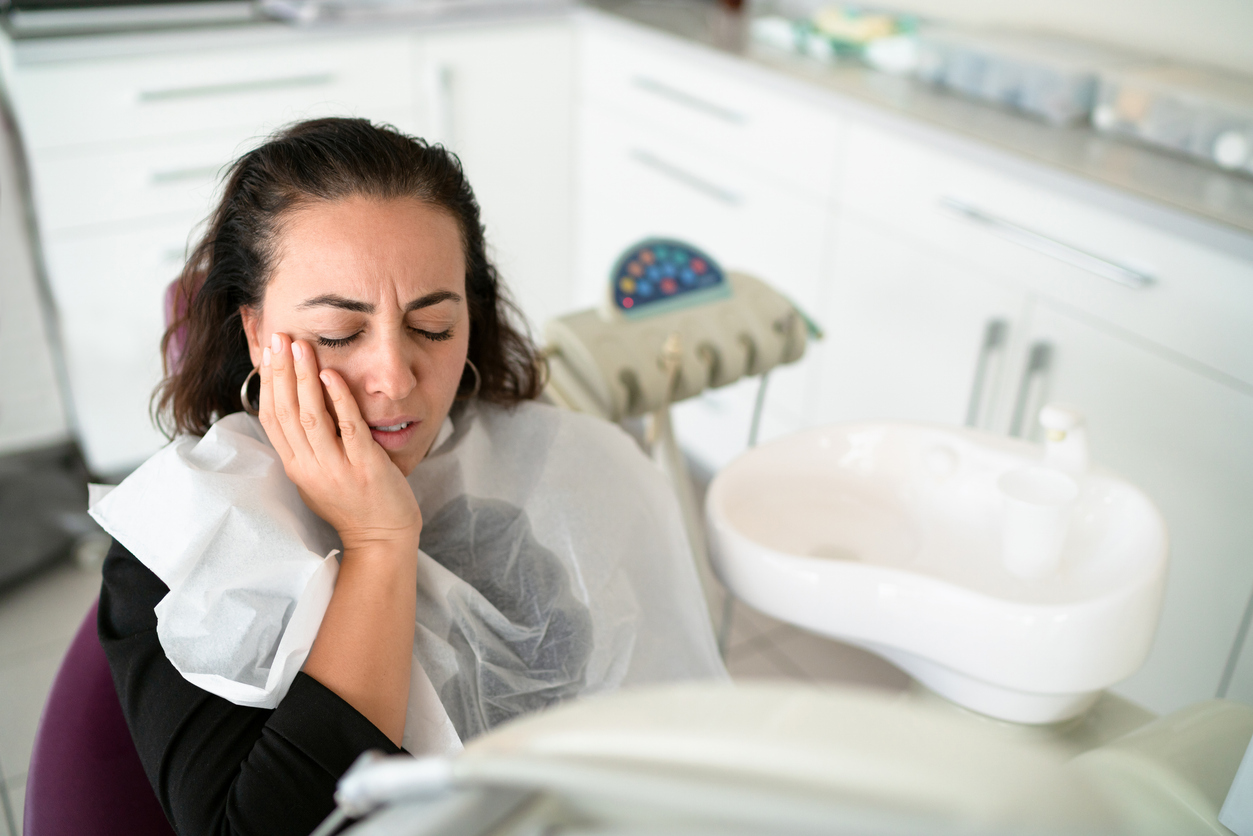
A patient who searches for dental emergency care near me at two in the morning is usually describing one thing: a tooth that hurts. The description that follows tends to be short, and it tends to sound like every other description. It throbs. It aches. It turns sharp when something cold touches it. Those words are accurate, and they are also shared by conditions that differ completely in cause, urgency, and treatment. The same sentence can belong to a cracked filling, an inflamed nerve, an infection forming at a root tip, a sinus inflamed above the upper back teeth, or a tooth still settling after recent dentistry. This is the central difficulty of dental emergency care near me: the symptom is the starting point, not the answer. What follows explains what a clinician is actually distinguishing between when a patient arrives for dental emergency care near me, which tests separate one possibility from another, and why an examination, rather than a description, is what settles the question.
Why the Words a Patient Uses Do Not Identify the Problem Behind Dental Emergency Care Near Me
Language for pain is limited. English offers only a handful of useful adjectives, so patients often use the same words. Two people may call very different sensations throbbing. Another person may use that word for pain that does not involve a tooth at all. The body does not send pain signals in a form that people can report with precision.
A description alone cannot settle the question for another reason. Dental pain often fails to identify its source. Nerves from the upper and lower teeth travel together. The brain may assign the signal to a neighboring tooth, the opposite arch, the ear, or the temple. A patient seeking dental emergency care near me may point confidently to a tooth that later tests healthy. That is not carelessness. It is ordinary anatomy.
What the Character of Discomfort Suggests During Dental Emergency Care Near Me
Clinicians consider how discomfort behaves, but they treat it as one clue rather than a verdict. Sharp sensations that disappear within seconds raise one set of possibilities. Dull, heavy sensations that fade slowly raise another. This distinction helps determine which tests come first. It does not name the condition by itself.
That caution has a simple reason. The same tooth can produce both patterns at different stages. Pain can also make a patient’s memory of an earlier sensation less precise. Descriptions may shift after a patient hears a possible explanation. A clinician handling dental emergency care near me uses the description to decide where to look. Then, the clinician confirms or rules out each possibility with testing. Patients do not need to classify the sensation before they arrive. Nothing here is a checklist for doing so.
Pain on Biting and What a Clinician Considers in Dental Emergency Care Near Me
Pain that occurs when a tooth takes pressure directs attention to structures that respond to force. The ligament holding the tooth in bone can become tender from inflammation. The tooth can also flex along a crack that is not visible from the outside. A high spot on a recent filling or crown can cause the same complaint. So can inflammation near the root tip.
Those possibilities need different treatment. The sensation alone cannot reliably separate them. During dental emergency care near me, a clinician applies controlled force, loads individual cusps, taps gently along the arch, and checks how the teeth meet. The clinician compares the results across several teeth. Biting on something at home to test a theory provides far less information and may drive a fracture deeper.
Cold Sensitivity That Fades Versus Cold Sensitivity That Lingers in Dental Emergency Care Near Me
Cold causes a response in almost everyone, and a brief response is ordinary. Clinicians watch what happens after they remove the cold. A sensation that disappears almost immediately points in one direction. A lingering sensation points in another. Lingering may suggest that the nerve tissue inside the tooth is inflamed rather than merely reactive.
This observation is useful only under controlled conditions. In a clinical setting, the clinician applies a standard stimulus to one tooth at a time. The clinician then compares its response with healthy teeth in the same mouth and times the response. At home, ice water touches several teeth at once, and timing is unreliable. A patient who reports cold sensitivity to an office offering dental emergency care near me provides a useful starting observation. It is not a finished finding. That difference is the point of the appointment.
Discomfort That Wakes a Patient at Night and Why Dental Emergency Care Near Me Takes It Seriously
Pain that interrupts sleep carries weight in a dental history. Lying down changes blood flow to the head. Pressure can rise inside an inflamed space. Daytime distractions also disappear at night. A patient who wakes repeatedly is usually describing a problem that has moved beyond its earliest stage.
That pattern calls for prompt evaluation, not a diagnosis. Night discomfort can occur with nerve inflammation, root infection, sinus involvement, or jaw joint and muscle problems. The pattern suggests that waiting and watching may be the wrong plan. It does not show which cause is responsible. An office providing dental emergency care near me schedules the examination sooner because of that detail. It never uses the detail as a shortcut past an examination.
Pressure Across Several Upper Teeth and Why Sinuses Enter Dental Emergency Care Near Me
When a patient describes fullness or pressure spread across several upper back teeth at once, rather than a single tooth, the conversation widens. The roots of the upper molars and premolars sit directly beneath the floor of the maxillary sinus, separated in some people by very little bone. Inflammation in that sinus can press on the same nerves serving those teeth, and the resulting sensation is genuinely tooth-like.
The reverse happens as well. Infection originating at the root of an upper tooth can inflame the sinus above it. Because the two situations can feel similar and require different treatment, a clinician handling dental emergency care near me asks about recent congestion, about whether the discomfort changes when the head is lowered, and then tests the individual teeth to see whether any one of them responds abnormally. A patient is not expected to work out which direction the problem is traveling; separating the two is specifically what the examination and the imaging are for.
Discomfort After Recent Dental Work and Its Place in Dental Emergency Care Near Me
Teeth that have recently been treated are often sensitive for a while. Preparing a tooth, removing decay close to the nerve, and placing a restoration are all disturbances, and the tissue inside responds by becoming temporarily irritable. Sensitivity to cold and mild tenderness on chewing in the days and weeks after treatment are common, usually improve steadily, and frequently resolve without further intervention.
What matters is the trajectory. Discomfort that is slowly easing is behaving the way recovering tissue behaves. Discomfort that is intensifying, spreading, or changing character is behaving differently, and a dentist wants to know about it. There is also a mechanical possibility worth checking, since a restoration sitting even slightly high concentrates force on one tooth and keeps it inflamed. None of this is something a patient should try to sort out alone. An office that handles dental emergency care near me would rather examine a tooth that turns out to be settling normally than hear about a worsening problem weeks later.
A Tooth That Stopped Hurting and Why Dental Emergency Care Near Me Still Investigates
One of the more misleading developments in dentistry is a severe toothache that fades on its own over a day or two. The natural reading is that the problem resolved. Sometimes it did. Sometimes, though, the nerve tissue inside the tooth has stopped signaling because it is no longer viable, and the underlying process continues quietly at the root tip where there is nothing left to register it.
That second scenario frequently announces itself later as swelling or as a dull pressure when the tooth is touched, by which point more treatment is required than would have been needed earlier. Because the two outcomes feel identical from the outside, a clinician providing dental emergency care near me generally wants to examine a tooth that hurt significantly and then went silent, even when the patient now feels fine. Testing and imaging distinguish a tooth that recovered from a tooth that stopped reporting. The relief itself distinguishes nothing.
Swelling and How It Changes the Timing of Dental Emergency Care Near Me
Swelling reorders the questions. Once facial or gum tissue is visibly swollen, the first issue is no longer what the condition is but how quickly it has to be seen, because infection in the tissue spaces of the face and neck can progress. A small, localized swelling beside a single tooth and a swelling extending across the cheek, closing an eye, or pushing up the floor of the mouth sit at very different points on that scale.
Swelling accompanied by fever, by difficulty breathing or swallowing, or by rapid spread is not a situation for a dental office at all; it belongs at a hospital emergency department without delay. Short of that, a patient who notices swelling should contact a dental office promptly rather than wait for a convenient opening, and an office offering dental emergency care near me will typically want that patient evaluated the same day. Timing, in these situations, is itself part of the treatment.
The Tests Used to Tell Conditions Apart in Dental Emergency Care Near Me
The examination exists because the history cannot finish the job. Temperature testing applies a controlled cold stimulus to one tooth at a time and records how that tooth responds and, importantly, how long the response lasts. Percussion testing taps lightly along the biting surfaces, since a tooth whose supporting ligament is inflamed answers differently from its neighbors. Pressure applied to the gum tissue over a root, movement checked with an instrument, and a bite examined with marking paper all add further information.
The value of these tests comes from comparison. A single response means little in isolation; a response that differs sharply from the same test on an adjacent or opposing tooth in the same mouth means a great deal. That is why dental emergency care near me involves testing several teeth rather than only the one a patient identifies, and why these procedures have no useful home version. They depend on controlled stimuli and trained interpretation.
What a Radiograph Adds to Dental Emergency Care Near Me
Clinical testing describes how tissue is behaving; a radiograph shows structure that behavior alone cannot reveal. It can show decay traveling beneath a restoration, the outline of a previous root canal, bone loss around a root tip that indicates a long-running process, a fracture line in some orientations, and the relationship between upper roots and the sinus floor above them.
Imaging has limits worth stating plainly. A radiograph is a flat picture of a three-dimensional object, and some cracks never appear on one at all. Changes in bone take time to become visible, so a very recent problem can produce a film that looks unremarkable while the tooth is clearly symptomatic. For those reasons, imaging taken during dental emergency care near me is read together with the clinical tests rather than instead of them. The two sources answer different questions, and a diagnosis usually rests on agreement between them rather than on either one by itself.
Why Neighboring Teeth Get Tested During Dental Emergency Care Near Me
Patients are sometimes puzzled when a clinician tests teeth that feel perfectly comfortable. The reason is referred pain. The nerve supply to the teeth is arranged so that signals from one tooth are routinely perceived as coming from another, most often a neighbor, frequently the tooth directly opposite in the other arch, and occasionally as an ache in the ear, the temple, or along the jaw.
Testing only the tooth a patient points to therefore risks treating a healthy tooth while leaving the actual source untouched, an error that is both avoidable and costly. Appointments for dental emergency care near me consequently include the teeth on either side of the suspected one and the matching teeth in the opposing arch, with the responses compared across the whole group. The tooth that reacts differently from the rest is the one that earns further attention, and it is not always the tooth that hurt.
When the Source Cannot Be Identified on a First Visit for Dental Emergency Care Near Me
Sometimes the tests disagree, the imaging looks unremarkable, and the picture simply does not resolve. Early nerve inflammation, hairline cracks, and jaw muscle pain that mimics a tooth are all capable of producing confusing results, and an honest clinician says so rather than selecting a tooth and treating it on the strength of a guess.
What follows in that situation is usually a short, deliberate period of observation. Measures that do not remove tooth structure may be taken, the bite may be adjusted where it is clearly uneven, and the patient returns for retesting once the condition has had time to declare itself more plainly. Conditions that are ambiguous early often become obvious within days. Referral to a specialist is another reasonable step. A visit for dental emergency care near me that ends with a clear plan to reassess is a far better outcome than one that ends with irreversible treatment on the wrong tooth.
Situations That Belong at a Hospital Rather Than Dental Emergency Care Near Me
Some presentations sit beyond the scope of any dental office, and recognizing them matters more than identifying which tooth is involved. Difficulty breathing or swallowing, swelling that is spreading across the face or neck or lifting the floor of the mouth, fever occurring together with facial swelling, bleeding that will not stop, and any significant injury to the head or jaw all call for a hospital emergency department immediately rather than an appointment with a dentist.
The reasoning is practical. A hospital has imaging, intravenous access, airway management, and surgical support that a dental office does not, and infections in the spaces of the face and neck can move quickly. Nothing in a discussion of dental emergency care near me should delay a trip to an emergency department when any of those signs is present. A dentist can address the tooth afterward, and routinely does; the hospital addresses the part of the situation that will not wait.
Why Patients Choose August de Oliveira DDS for Dental Emergency Care Near Me
August de Oliveira DDS practices at 5400 Balboa Blvd #231 in Encino, CA 91316, with office hours Monday through Thursday from 8 to 5 and Friday appointments arranged in advance. Patients travel to the practice from Encino, Sherman Oaks, Van Nuys, Tarzana, Calabasas, Woodland Hills, Studio City, and Reseda.
The clinical focus of Dr. de Oliveira is digital dentistry, and the office runs both chairside CEREC and full laboratory workflows. For a patient arriving with an unclear source of discomfort, that combination helps in a specific way: digital imaging and digital records make it straightforward to compare findings across visits, and having both a same-day pathway and a laboratory pathway available means the restorative plan can follow the diagnosis instead of the diagnosis being shaped by what the office is able to produce. When a tooth needs observation before a final decision, the practice is equipped to look again carefully. Patients seeking dental emergency care near me are asked to contact the office so an appointment can be arranged.
Final Thoughts on Dental Emergency Care Near Me
A toothache is a symptom, not a diagnosis. The same description can belong to an irritated nerve, a cracked tooth, an infection at a root tip, an inflamed sinus, a restoration sitting slightly high, or a tooth that has quietly stopped signaling, and only a clinical examination combining testing and imaging separates them. Nothing written here is meant to help a patient reach a conclusion independently; the point is the opposite, which is that similar symptoms have genuinely different causes and that an examination is what tells them apart.
This article is general information. It is not a diagnosis and not medical advice. Anyone experiencing dental pain, swelling, or any of the hospital-level signs described above should contact a dentist or a physician directly rather than rely on general reading. Patients in Encino and the surrounding communities looking for dental emergency care near me are invited to contact August de Oliveira DDS to schedule an examination and have the question answered properly.