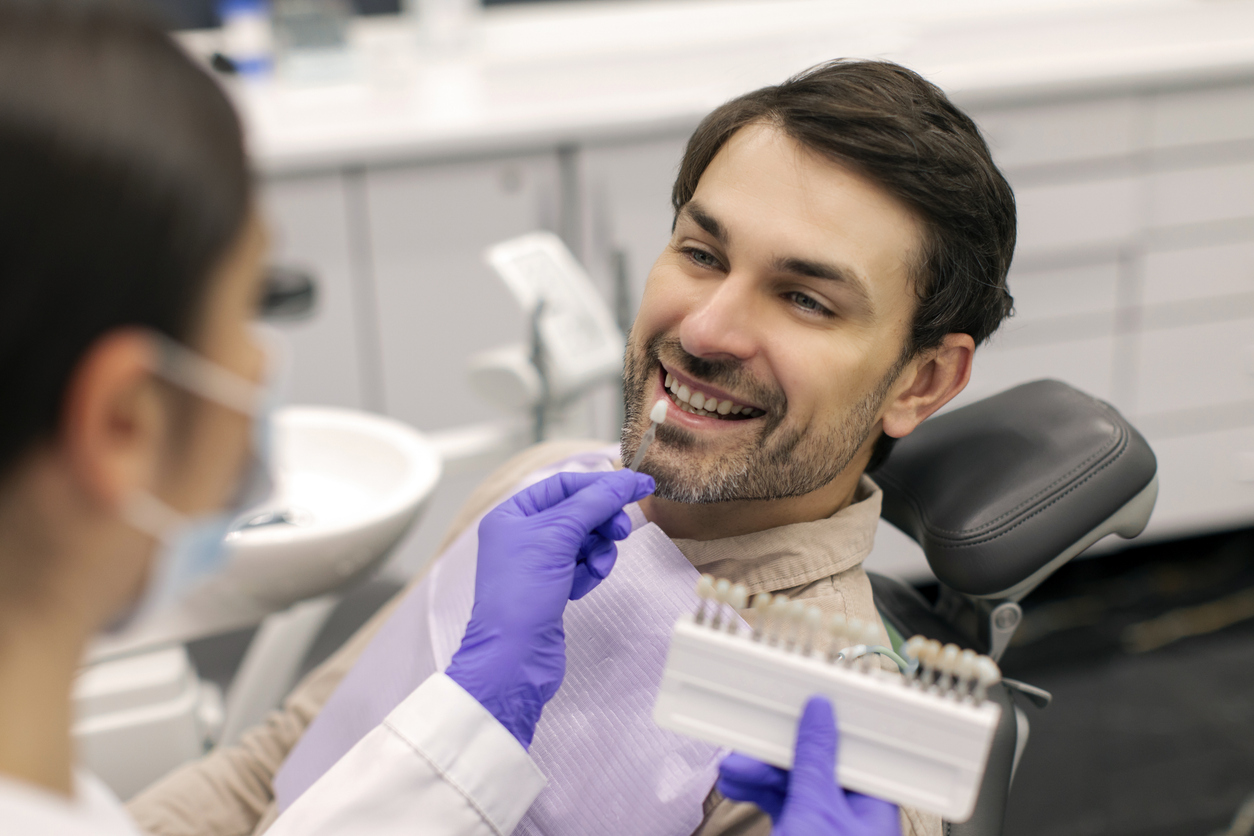
Most discussions of cosmetic dentistry concentrate on design: length, width, midline, how much tooth shows when the lips part. Those decisions matter, and they take up most of the consultation. Underneath them sits a quieter decision, made earlier and reversed far less easily, which is what the restoration will actually be made of. Composite resin, feldspathic porcelain, pressed glass ceramic, and zirconia are not interchangeable. They carry light differently, they wear differently, they pick up stain differently, and they fail in different ways. A cosmetic dentist Encino CA patients visit chooses among them before a single contour is drawn, because the material sets the limits the design has to work inside. That choice also decides how the result reads after years of coffee, chewing, and ordinary function. What follows is an account of how each material class behaves over time, and how a cosmetic dentist Encino CA weighs those behaviors against one particular mouth rather than against a general preference. Nothing in a restored smile ages uniformly, and a cosmetic dentist Encino CA plans around that fact.
Why Material Class Comes Before Shape in Work by a Cosmetic Dentist Encino CA
Design decisions can change on paper. Material decisions cannot. Each class has its own minimum thickness, bonding behavior, and optical range. Very thin facial coverage rules out several materials at once. Heavy clenching rules out others. For that reason, a cosmetic dentist Encino CA resolves the material question early. The dentist then designs contours the selected material can deliver. The reverse order creates designs that may not be possible to build. It can also place the design in a poorly suited material. Material thickness also determines how much tooth structure must be reduced. Patients often understand the rejected shapes once they understand this sequence. The discussion shifts from preference to performance. It considers what a ceramic or resin can bond to, transmit light through, and withstand under load.
Direct Composite Bonding and What a Cosmetic Dentist Encino CA Asks of It
A dentist places and shapes composite resin directly in the mouth during one visit. The dentist cures it in layers, then contours and polishes it by hand. Many cases require no tooth removal. That makes composite a conservative option for chipped edges, small gaps, and minor shape corrections. It is also highly adjustable. A dentist can smooth a margin or lengthen an edge. The dentist can also redo an entire surface without involving a laboratory. Composite is softer and more porous than ceramic. As a result, it changes over time in ways porcelain does not. A cosmetic dentist Encino CA may recommend bonding to preserve enamel and maintain reversibility. That trade can be especially appropriate for younger patients or a single tooth. Still, bonded work needs maintenance. Patients should understand that expectation before treatment begins, not at the first polishing visit.
How Composite Margins Stain and What a Cosmetic Dentist Encino CA Can Polish Back
Composite does not discolor evenly. Its surface slowly loses polish. Visible change often begins at the margin, where resin meets enamel. This microscopic seam collects pigment from coffee, tea, red wine, and tobacco first. It can create a faint dark line around work that looked invisible on the day of placement. Much of this change comes from surface deposits, not internal discoloration. A cosmetic dentist Encino CA can often improve the appearance by repolishing the restoration and refinishing the margin. Polishing cannot remove pigment that has entered the resin matrix. It also cannot close a margin that has started to open. In those cases, the dentist replaces the surface layer rather than simply cleaning it. Patients who schedule routine polishing often keep bonded work more consistent. They do not wait until the margin stands out in photographs.
Feldspathic Porcelain and the Aesthetic Ceiling a Cosmetic Dentist Encino CA Works Toward
A technician builds feldspathic porcelain by applying powdered ceramic in successive layers to a model. The technician fires the work between applications. Each layer can vary in opacity, chroma, and translucency. This process can imitate a natural tooth’s internal structure, not merely its surface color. It can create incisal depth, subtle white flecks, and a slight halo at the biting edge. It can also reproduce value changes from the gingival third to the tip. Feldspathic porcelain offers the highest aesthetic ceiling. A cosmetic dentist Encino CA may choose it for thin, anterior, visually demanding cases. The tradeoff is mechanical strength. Hand-layered porcelain is more fragile than stronger ceramics. It depends on adhesive support from underlying enamel and a bite that does not overload it. It rewards gentle function and performs less predictably under heavy force.
Pressed Glass Ceramic as the Middle Ground a Cosmetic Dentist Encino CA Reaches For
Pressed glass ceramics sit between layered porcelain and high-strength ceramics. That position explains much of their popularity. They are tougher than hand-layered feldspathic work. They also retain enough translucency to look convincing in the front of the mouth. Their glass phase can be etched and treated. This creates a strong chemical union with resin cement. A dentist can mill these ceramics chairside from a block or press them in a laboratory. They also accept surface staining and a thin porcelain layer for added character. For many veneer, inlay, onlay, and single-crown cases, a cosmetic dentist Encino CA chooses this category. It performs several jobs well rather than one job exceptionally. The compromise exists at both ends. It lacks the full optical subtlety of layered porcelain. It also does not match zirconia’s fracture resistance in a heavy bite.
Zirconia, Strength, and the Translucency Tradeoff a Cosmetic Dentist Encino CA Weighs
Zirconia is among the toughest common dental ceramics. It is often the choice when force drives the decision. Typical situations include molars, long spans, and patients with a history of fractured restorations. Its dense crystalline structure gives zirconia its strength. That structure also makes it appear more opaque. Natural teeth scatter light and allow it to continue through the tooth. Highly crystalline ceramic reflects more light back sooner. Next to enamel, it can look flat or slightly lifeless. Manufacturers now offer more translucent zirconia formulations. Yet translucency and strength usually move in opposite directions within this material class. A cosmetic dentist Encino CA considers where the restoration sits and what it must survive. Zirconia is not a universal upgrade. It also requires a different bonding approach because its surface does not etch like glass ceramic.
Monolithic Versus Layered Restorations and Where a Cosmetic Dentist Encino CA Expects Chipping
A monolithic restoration comes from one uniform piece of material. A laboratory may mill or press it. A layered restoration uses a stronger core and adds more translucent ceramic, often on the facial surface. Layering adds optical depth. It also creates an interface where failures can begin. In layered work, the veneering ceramic most often chips while the core remains intact. A cosmetic dentist Encino CA may choose a monolithic restoration for a heavily loaded bite. The dentist can recover some character with surface staining and glazing instead of added layers. Monolithic work is more forgiving and often easier to maintain. Layered work can look better in the hands of a skilled technician. However, it asks more of the bite. The choice usually comes down to which failure mode is least acceptable.
How Each Material Handles Light Compared With Enamel in a Cosmetic Dentist Encino CA Case
Natural enamel is translucent and slightly blue at the edge, while the dentin beneath it is more opaque and more saturated. Light passes through enamel, scatters in dentin, and returns to the eye having been filtered twice. That is why a real tooth looks like it has depth rather than color. Materials differ in how closely they reproduce this. Layered porcelains come nearest because they can be built with an opaque body and a translucent surface. Glass ceramics approximate it reasonably well. Composite resin starts close and drifts as its surface polish breaks down. Zirconia reflects more and transmits less. A cosmetic dentist Encino CA considers the optical question alongside the mechanical one, because a restoration that is strong and correctly shaped can still look artificial if the light behaves wrongly. The effect is most noticeable on upper front teeth in natural daylight, which is where mismatches get photographed and noticed.
The Bonded Interface a Cosmetic Dentist Encino CA Treats as the Real Variable
Ceramic in the hand is brittle. Ceramic bonded to enamel behaves as part of a composite structure and becomes far more durable, which is why the quality of the adhesion often matters more than the choice between two good ceramics. Bonding to enamel is predictable. Bonding to dentin is less so, and bonding to an old restoration or a tooth that has been heavily prepared is less predictable again. This is one of several reasons a cosmetic dentist Encino CA treats preserving enamel as a functional decision rather than a philosophical one, since the material left behind is the substrate the restoration depends on. Isolation during cementation matters too, because moisture contaminating the bonding surface weakens the result in a way that cannot be seen afterward. Restorations that debond frequently do so because the interface was compromised rather than because the ceramic was wrong for the case. Two identical ceramics bonded under different conditions will not behave the same way over the following years.
Thickness Requirements and How Much Tooth a Cosmetic Dentist Encino CA Must Remove
Every material has a thickness below which it becomes unreliable, and those minimums differ across classes. A strong ceramic can be made thinner than a weak one. A material intended to mask an underlying dark tooth needs more thickness than one placed over a tooth that is already close to the target shade. That arithmetic determines reduction, because the restoration needs room, and room comes from the tooth. A cosmetic dentist Encino CA who selects a bulkier material for a given case is also committing to removing more structure, which is a consequence worth stating plainly at the planning stage. The reverse holds as well. Choosing a material that performs in a thin section keeps reduction minimal and sometimes avoids it entirely. The relationship runs in one direction only: the material sets the thickness, the thickness sets the reduction, and the reduction cannot be taken back later. Discussing the material class early is therefore the same conversation as discussing how much enamel will remain.
Matching Material to Bite and Grinding History With a Cosmetic Dentist Encino CA
A material that performs well in one mouth can fail quickly in another, and the variable is usually force. Wear facets on the existing teeth, a history of broken fillings, morning jaw soreness, and flattened canine tips all point toward parafunction, and parafunction changes the calculation entirely. Under those conditions the more fragile and beautiful materials become poor candidates for load bearing surfaces, however well they would have looked. A cosmetic dentist Encino CA examining a patient with a grinding history will generally move toward tougher ceramics, monolithic construction, or a design that keeps the delicate material away from contact, and will usually include a night guard as part of the plan rather than as a response to the first fracture. What the opposing teeth are made of matters as well, since a hard ceramic opposing natural enamel wears the enamel, and that wear accumulates quietly over years. A restoration that survives perfectly while damaging the tooth above it has not really succeeded.
What Happens When Different Materials Sit Side by Side in a Cosmetic Dentist Encino CA Case
Mixing materials within one visible zone creates a problem that does not appear at delivery and becomes obvious later. Two restorations matched carefully on the day of cementation can diverge over several years because they age on different schedules. Composite dulls and takes up stain. Glass ceramic holds its surface well. Zirconia stays stable in color but never quite matched its neighbors optically to begin with. The result is a smile that looked uniform once and now reads as patched. A cosmetic dentist Encino CA plans the boundary of the restored zone with this in mind, keeping a single material class across the teeth the eye reads together whenever the case allows, and placing any transition where the arch curves away from view. Where mixing is unavoidable, the more durable material usually goes where force is highest and the more lifelike one goes where visibility is highest. The point of the plan is that the divergence is anticipated rather than discovered in a photograph years afterward.
Repairability and What a Cosmetic Dentist Encino CA Can Mend in the Chair
Materials differ in what can be done after something goes wrong, and that difference is rarely discussed before treatment. Composite is the most repairable; a fractured corner can usually be rebuilt against the existing resin in one appointment. Glass ceramics can sometimes be repaired with bonded composite, because the ceramic surface can be etched and treated to accept a resin patch, though the repair will not match the surrounding material perfectly over time. Zirconia is the hardest to mend, since its surface does not bond to resin as readily, and a significant fracture often means remaking the restoration. Layered work has a middle position: chipped veneering ceramic can occasionally be smoothed or patched, but a large loss generally means replacement. A cosmetic dentist Encino CA raises repairability during planning because it changes what a future problem will cost in time, in further tooth reduction, and in disruption to the rest of the case.
How a Decade of Wear Tests the Material a Cosmetic Dentist Encino CA Selected
Over a long span, each class shows its character. Composite loses surface gloss, accumulates marginal staining, and benefits from periodic polishing and occasional resurfacing. Layered porcelain holds its appearance remarkably well when the bite protects it, and its most likely event is a chip rather than gradual decline. Glass ceramic tends to be undramatic, keeping its color and surface with routine care. Zirconia changes least of all optically, which can become its own issue as the natural teeth beside it darken with age while the restoration does not. Gum tissue migrates in every case, and margins that were hidden can become visible regardless of material. A cosmetic dentist Encino CA therefore frames each class not as permanent or impermanent but as carrying a particular maintenance profile, with a known schedule of examination, polishing, bite checks, and eventual service. Patients who hear that profile before treatment are rarely surprised by it afterward.
Why Patients Choose August de Oliveira DDS as a Cosmetic Dentist Encino CA
August de Oliveira DDS practices at 5400 Balboa Blvd #231, Encino, CA 91316, with office hours Monday through Thursday from 8 to 5 and Friday by appointment. The practice serves patients from Encino, Sherman Oaks, Van Nuys, Tarzana, Calabasas, Woodland Hills, Studio City, and Reseda. Dr. de Oliveira’s focus is digital dentistry, and the office runs both chairside CEREC and full laboratory workflows, which is directly relevant to the subject of material selection. Having both pathways available means the material can be chosen to fit the case rather than the case being shaped to fit whichever workflow the office happens to use. A single unit that suits a milled ceramic can be designed, produced, and bonded in one visit. A case that calls for hand layered porcelain and a technician’s judgment goes to the laboratory instead. A cosmetic dentist Encino CA with access to both routes is not forced to compromise on the material question.
Final Thoughts on Choosing a Cosmetic Dentist Encino CA
Material selection is the part of cosmetic dentistry that patients see least and live with longest. The shape of a restoration is settled in a design appointment; what it is made of determines how that shape survives a decade of coffee, chewing, clenching, and daily brushing. There is no single best material, only a reasonable match between a material class, a specific tooth, a specific bite, and a specific set of expectations about appearance and maintenance. That matching is the work, and it is why a cosmetic dentist Encino CA asks about grinding, diet, and history before discussing shade. This article is general information and not a treatment recommendation; material selection depends on an examination of the individual mouth. Patients in Encino and the surrounding communities who want to understand which materials suit their situation are invited to call August de Oliveira DDS at 5400 Balboa Blvd #231 in Encino to schedule a consultation.