Most people research orthodontics for months before they start and stop researching the moment the trays arrive. That leaves the second half of the story unexamined, and the second half is the part that decides whether the alignment lasts five years or fifty. Retention is not an accessory to clear aligners Encino treatment; it is the phase that determines whether the biology accepts the new tooth positions or slowly pulls them back toward where they started. Teeth are not set in concrete. They sit in a living attachment apparatus that stretches, stores tension, and remodels on its own timeline. This article begins on the day the final tray comes out of your mouth for the last time, and it covers what happens next: the fiber biology behind relapse, the highest risk window, the real retainer options and their tradeoffs, hygiene, replacement, late crowding, and what to do if retention lapses for years after clear aligners Encino treatment. Everything here is about keeping the result you already paid for with clear aligners Encino care.
What Happens When Clear Aligners Encino Treatment Reaches the Last Tray
The final tray is rarely the true finish line. When the last aligner in the original series comes out, the treating dentist compares the actual tooth positions against the digital plan and looks for the small discrepancies that accumulate over dozens of stages: a rotation that did not fully express, a contact point that stayed slightly open, a root angulation that lagged behind the crown. A second short series, commonly called refinement aligners, is issued to close those gaps. Refinement is a normal, expected part of clear aligners Encino treatment rather than evidence that something went wrong. Plastic moves teeth through predicted tracking, and predicted tracking and biological response are never identical across every tooth in an arch. Most refinement runs are shorter than the original series, often a handful of trays over a few weeks or a couple of months. Only after refinement is complete does retention planning begin in earnest, because a retainer built over an unfinished result simply locks in the unfinished result.
Why Teeth Move Back After Clear Aligners Encino Treatment
A tooth is suspended in its socket by the periodontal ligament, a band of collagen fibers that anchors cementum to alveolar bone. Above the crest of that bone sits a second group, the supracrestal gingival fibers, which weave through the gum tissue and encircle each tooth. Both fiber groups stretch when a tooth is moved, and both retain elastic memory long after the crown looks perfectly aligned. The periodontal ligament fibers reorganize comparatively quickly, over a few months. The supracrestal gingival fibers are far slower and can hold recoil tension for a year or more, which is why rotations are the single most relapse prone correction in clear aligners Encino treatment. Bone runs on a third schedule. Osteoclasts resorb bone ahead of a moving root and osteoblasts lay new bone behind it, but full mineralization and maturation of that new bone lags well behind the visible result. Until all three systems settle, only a retainer holds the position.
The First Three to Six Months After Clear Aligners Encino Treatment
The window immediately after active movement stops is the highest risk period in the entire case. The periodontal ligament is still reorganizing, the newly deposited bone is immature, and the gingival fibers are at their maximum stored tension. This is why full-time retainer wear, typically twenty to twenty-two hours a day with removal only for meals and cleaning, is usually prescribed for the first three to six months after clear aligners Encino treatment. Patients who cut this phase short often notice it within days rather than weeks. A retainer that felt loose and effortless on Friday feels tight on Monday, which is a direct signal that teeth have already begun to drift. After that initial period, most patients step down to nightly wear, and the transition is based on how the retainer fits at follow-up rather than on the calendar alone. If a retainer still seats with noticeable pressure, the full-time phase is extended rather than shortened.
The Honest Long Term Answer About Retention After Clear Aligners Encino Treatment
There is no date at which retention becomes unnecessary. The accurate answer, and the one worth hearing before treatment rather than after, is that retainers are worn nightly and indefinitely. Teeth continue to migrate throughout adult life whether or not a person has ever had orthodontic treatment, driven by lip and tongue pressure, chewing forces, occlusal wear, and the natural mesial drift of the dentition. A retainer worn while sleeping counters all of it with minimal effort. Framing retention as a permanent nightly habit rather than a temporary chore is the most useful thing a patient can take away from clear aligners Encino treatment. In practice, nightly wear is roughly seven hours out of twenty-four, requires no adjustment to daytime life, and costs almost nothing once the appliance exists. Patients who accept this from the beginning tend to keep their alignment. Patients who treat retention as an endpoint to be reached almost always return years later with visible change.
Vacuum Formed Clear Retainers After Clear Aligners Encino Treatment
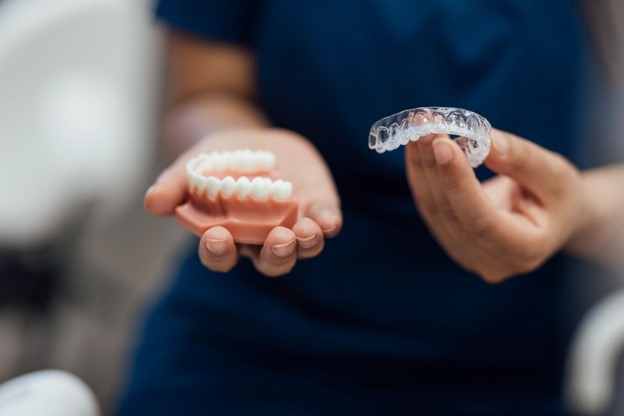
The vacuum formed clear retainer is a thin thermoplastic shell pressed over a model of the finished arch. It looks and feels like the aligners the patient just finished wearing, which makes acceptance easy after clear aligners Encino treatment. It covers the full occlusal surface, holds rotations and tipping well, and is essentially invisible. The tradeoffs are material based. Thermoplastic wears thin at the incisal edges and over occlusal contacts, particularly in patients who clench or grind, and a worn retainer no longer applies even holding pressure. It is also vulnerable to heat. Anything above roughly 120 degrees Fahrenheit begins to distort the plastic, which means a car dashboard in a San Fernando Valley summer can ruin one in an afternoon. Full occlusal coverage also prevents the back teeth from touching during wear, which is fine at night but is a consideration in patients being monitored for occlusal changes. These retainers are consumable rather than permanent.
Hawley Retainers as an Option After Clear Aligners Encino Treatment
The Hawley retainer is the older design and remains a legitimate choice. It consists of an acrylic body that rests against the palate or the lingual surfaces of the lower arch, retained by wire clasps on the molars, with a labial bow crossing the front teeth. Its advantages are durability and adjustability. Acrylic and wire tolerate years of use where thermoplastic does not, and the labial bow and clasps can be tightened or modified chairside if a minor correction is needed, something impossible with a sealed plastic shell. It also leaves the occlusal surfaces free, so the back teeth settle into contact naturally. The drawbacks are visibility and bulk. The labial wire is noticeable when speaking, the acrylic takes up palatal space, and speech adaptation takes a few days. Some patients who finish clear aligners Encino treatment specifically to avoid visible appliances find the wire unacceptable, while others prefer the longevity and never look back.
Bonded Lingual Wire Retainers After Clear Aligners Encino Treatment
A bonded retainer is a thin multistranded wire cemented with composite to the lingual surfaces of the front teeth, most often the lower canine to canine segment and sometimes the upper incisors. Its defining advantage is that it removes compliance from the equation entirely. It is present every hour of every day without any decision from the patient, which makes it the most reliable single safeguard available after clear aligners Encino treatment. The tradeoffs are real. Flossing requires a threader, an interdental brush, or a water flosser, and plaque accumulates around the composite pads if hygiene slips, which can lead to calculus buildup and gingival inflammation. More significantly, a bonded retainer can fail silently. A single pad can debond while the wire stays attached to the neighboring teeth, so nothing feels loose, yet the freed tooth is now unretained and free to rotate or tip while the patient assumes everything is fine.
Why Many Patients Use Both Retainer Types After Clear Aligners Encino Treatment
The most common configuration in adult practice is a bonded wire on the lower front teeth combined with a removable retainer on the upper arch. The logic is anatomical. Lower incisors are the teeth most prone to late crowding across a lifetime, they are small, and they sit in the arch where tongue pressure, lip pressure, and mesial drift converge. A fixed wire addresses exactly that vulnerability without depending on nightly memory. The upper arch has more room, better access, and larger teeth, so a removable retainer is generally sufficient there and much easier to keep clean. Many patients who complete clear aligners Encino treatment also wear a removable lower retainer over the bonded wire at night, which adds a second layer of holding force and, usefully, will stop seating properly if the bonded wire has quietly failed. That combination gives redundancy at a low cost in daily effort.
Retainer Hygiene and Heat Damage After Clear Aligners Encino Treatment
Clear retainers are cleaned with cool water and a soft brush, and nothing else by default. Hot water is the most common way patients destroy their own appliance. Rinsing under a hot tap, soaking in boiling water to sanitize, or running a retainer through a dishwasher will warp the thermoplastic, and a warped retainer no longer fits the arch it was made for. Leaving one in a parked car produces the same result. Regular toothpaste is the second common mistake. The abrasives that polish enamel scratch soft plastic, and those microscratches trap stain and cloud a retainer that started out invisible. A soft brush with plain water, or a retainer specific cleaning tablet used as directed, keeps the surface clear. Hawley retainers tolerate brushing better but still should not be exposed to heat, since the acrylic can distort. Every patient finishing clear aligners Encino treatment should also get in the habit of using the case rather than a napkin.
Replacement Intervals and Stored Digital Models After Clear Aligners Encino Treatment
Clear retainers are wear items. With nightly use, many last somewhere in the range of one to three years before the plastic thins, cracks at a clasp area, or loses the crisp fit that makes it effective. Grinders replace them more often. Hawley retainers frequently last considerably longer with periodic adjustment. The practical strategy after clear aligners Encino treatment is to plan for replacement rather than react to a break, because the gap between losing a retainer and receiving a new one is exactly when teeth move. Keeping a spare set costs less than a remake plus the correction that a month of no retention can require. A stored digital scan matters just as much. When the finished arch exists as a digital file, a replacement can be produced from that record without another impression appointment, and it reproduces the position the teeth were actually in at the end of treatment rather than wherever they have drifted since.
How a Bonded Retainer Is Checked After Clear Aligners Encino Treatment
Because bonded wires fail without symptoms, they are inspected at every routine hygiene visit. The check is simple and takes seconds: the hygienist or dentist runs an explorer along each composite pad and applies light pressure to each bonded tooth individually, watching for independent movement. A pad that has debonded will let its tooth flex separately from the wire. Calculus buildup around the pads is also removed at these visits, since deposits there are difficult to reach at home. When one pad fails, the fix is usually straightforward. The composite is cleaned off, the enamel is re-etched, and the wire is rebonded, provided the tooth has not already moved out of the wire’s passive shape. If it has, the wire is removed, the tooth is realigned, often with a short run of aligners, and a new retainer is placed. This is one of the practical reasons patients who finish clear aligners Encino treatment are asked to keep six month recall intervals.
Late Lower Incisor Crowding and Lapsed Retention After Clear Aligners Encino Treatment
Lower incisor crowding increases with age in the general adult population, including people who never had orthodontic treatment. It is a lifelong tendency of the human dentition, driven by continued mandibular growth, soft tissue pressure, and mesial drift. It is not caused by wisdom teeth. That myth persists because the timing of third molar eruption in the late teens coincides with the age at which late crowding becomes noticeable, but correlation there is not causation, and removing third molars does not reliably prevent it. This is precisely why nightly retention after clear aligners Encino treatment is described as indefinite. When someone does stop wearing retainers for several years and the teeth shift, the situation is rarely as bad as it feels. Relapse tends to move teeth back along the path they traveled, so a short retreatment of a few months usually restores the result rather than a full second course of treatment.
Interproximal Reduction and Stable Contact Points After Clear Aligners Encino Treatment
Interproximal reduction, sometimes called enamel reduction or slenderizing, is the controlled removal of a small amount of enamel from the sides of teeth, typically a fraction of a millimeter per surface, using abrasive strips or thin discs. It creates space in a crowded arch without extractions, and it does something else that matters for retention. Teeth that are crowded or rotated meet their neighbors at a single tight point or at an awkward angle. Broadening those contacts into flat, well seated interproximal surfaces gives each tooth stable support on both sides, which resists the rotational relapse that stored gingival fiber tension produces. Planned interproximal reduction during clear aligners Encino treatment is therefore both a space solution and a stability measure. Performed within reasonable limits and with proper technique, it does not increase decay risk, and the reduced surfaces are polished and, where appropriate, treated with fluoride at the time.
Sequencing Whitening and Bonding After Clear Aligners Encino Treatment
Cosmetic finishing is deliberately scheduled after alignment rather than before it, and the order is not arbitrary. Whitening works on the surfaces that are exposed to the gel, so bleaching crowded or overlapped teeth leaves the previously hidden interproximal surfaces a different shade once the teeth are straightened. Composite bonding has the same problem in reverse. Bonding added to reshape a chipped or undersized incisor is matched to a tooth’s current position and angle, and moving that tooth afterward changes how the restoration reads and can leave the margin exposed. The efficient sequence after clear aligners Encino treatment is alignment first, then whitening, then any bonding or edge recontouring, with the composite shade selected against the newly whitened enamel. Retainers are usually fabricated after the bonding is complete so the appliance fits the final tooth shapes. Whitening gel can also be delivered in a dedicated tray rather than in the retainer itself.
Why Patients Choose August de Oliveira DDS for Clear Aligners Encino
August de Oliveira DDS is a cosmetic and implant dental practice at 5400 Balboa Blvd #231, Encino, CA 91316, serving patients from Encino, Sherman Oaks, Van Nuys, Tarzana, Calabasas, Woodland Hills, Studio City, and Reseda. Dr. August de Oliveira’s clinical focus is digital dentistry, and the office runs both chairside CEREC and full laboratory workflows. For retention specifically, that infrastructure has a concrete benefit. Digital scanning captures the finished arch as a stored file, so a lost or warped retainer can be remade from that record without a new impression appointment and without waiting for teeth to be re-scanned in whatever position they have drifted to. The same digital records support planning refinement stages, monitoring bonded retainer integrity over time, and coordinating the cosmetic finishing that often follows clear aligners Encino treatment. Office hours are Monday through Thursday, 8 to 5, with Friday available by appointment.
Final Thoughts on Clear Aligners Encino
The result you get on the last day of treatment is not a permanent state; it is a position that has to be held while the periodontal ligament reorganizes, the gingival fibers release their stored tension, and the alveolar bone finishes maturing, and then it has to be held against the ordinary lifelong drift of adult teeth. That is the entire argument for retention, and it is why the phrase after clear aligners Encino treatment should always be followed by a specific plan rather than a vague instruction to wear a retainer for a while. Understanding the biology makes the nightly habit easy to keep, and understanding the tradeoffs among clear, Hawley, and bonded retainers makes the choice a considered one. To discuss retention, refinement, replacement retainers, or clear aligners Encino treatment from the beginning, contact August de Oliveira DDS in Encino to schedule a consultation and have your options reviewed in person.