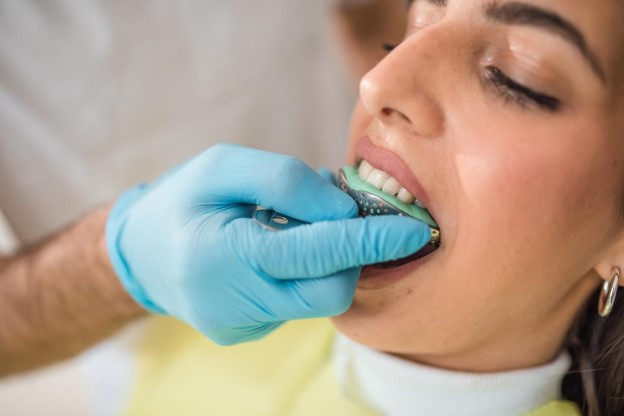
CEREC Same-Day Dental Crowns are completed in one visit, but life with a new crown is just beginning. After the anesthesia fades, the restoration must adapt to daily chewing, brushing, and flossing. Most changes happen quietly over the following weeks and months. Knowing the usual first-year timeline helps patients separate normal settling from concerns that need attention. This guide follows the first year, from mild early sensitivity to the one-year checkup, and explains what August de Oliveira DDS generally monitors at each stage.
CEREC Same-Day Dental Crowns and the Story That Begins After the Appointment
The hour-by-hour experience of getting CEREC Same-Day Dental Crowns has been covered elsewhere. It includes the scan, design, milling, and bonding in one visit. What happens afterward also affects the long-term outcome. A crown becomes a permanent restoration when the dentist bonds it. However, it does not immediately feel like part of a patient’s normal bite. The tooth nerve needs time to settle after preparation. The gum tissue around the margin also needs time to recover. Jaw muscles and joints gradually adapt to the new surface and bite pattern. The first year is a process of integration, not a single event.
The First Week With CEREC Same-Day Dental Crowns: Normal Settling vs Red Flags
Mild cold sensitivity is common in the days after delivery. The tooth nerve may react briefly after preparation and restoration. Tenderness when biting is also common during the first several days. The periodontal ligament around the root needs time to adjust to changed biting forces. Red flags are different. Call the office for sharp pain without a trigger, worsening sensitivity, spreading swelling, or pain that interrupts sleep. Those symptoms need evaluation. For most patients with CEREC Same-Day Dental Crowns, week one is mild, predictable, and steadily improves.
Weeks Two Through Four of CEREC Same-Day Dental Crowns: Sensitivity Should Be Shrinking
By the second week, the cold sensitivity that was noticeable right after delivery should be measurably less intense than it was on day one, and it should keep shrinking as weeks two, three, and four pass. This gradual decline, rather than a sudden disappearance, is the expected pattern. During this same stretch, a patient typically develops new habits around the crown without consciously deciding to: flossing with slightly more attention near the margin, noticing which side handles harder foods more comfortably, adjusting brushing angle around the new surface. These small behavioral shifts happen naturally as the mouth maps out the restoration’s exact shape and location. Some patients report that the crown feels slightly large or prominent during this window, simply because any new dental surface takes a few weeks to feel unremarkable. By the end of the first month, most of that awareness has faded, and a tooth restored with CEREC Same-Day Dental Crowns starts to feel like it has always been there.
Month One to Two With CEREC Same-Day Dental Crowns: The Bite Fully Equilibrates
Somewhere between the first and second month, the bite fully equilibrates. This is a mechanical process as much as a sensory one. Even though the crown is designed and milled to match the opposing teeth with digital precision, the surrounding muscles, ligaments, and jaw joint need time to settle into a stable pattern around the new contact points. Minor high spots that were not noticeable immediately after delivery sometimes become apparent as the bite settles, which is a normal part of the adjustment process rather than a sign that something went wrong initially. Residual soreness from the appointment itself, along with any lingering swelling in the gum tissue, should be fully resolved by this point. A patient who still notices consistent discomfort at the two-month mark, rather than isolated moments of adjustment, has moved outside the typical pattern for CEREC Same-Day Dental Crowns and should have that discomfort evaluated rather than waiting further. For most, though, month two marks the point where the bite simply feels normal again.
Month Two to Three of CEREC Same-Day Dental Crowns: The Gum Tissue Matures
Between roughly the second and third month, attention shifts from the bite to the gum tissue itself. The margin where the crown meets the natural tooth structure goes through a maturation process, and the tissue around it settles into its final contour during this window. Immediately after placement, gum tissue near the margin can appear slightly puffy or irregular as it recovers from the scanning and seating process. Over the following weeks, that tissue tightens and adapts to the exact shape of the restoration, producing a cleaner, more settled appearance around the crown. This is also the point at which the color and translucency of a well-matched ceramic crown tend to blend most naturally with the surrounding teeth, since any subtle changes in gum position or minor post-procedure discoloration have resolved. By month three, the tissue architecture around CEREC Same-Day Dental Crowns typically looks the way it will continue to look for years afterward.
Month Three to Six With CEREC Same-Day Dental Crowns: The Crown Disappears
Somewhere in the stretch between month three and month six, most patients stop thinking about the crown at all. This is arguably the real marker of success: not a specific measurement or checkup finding, but the point at which a restored tooth stops registering as different from the teeth around it during eating, speaking, and everyday function. The nerve has settled, the bite has equilibrated, the gum tissue has matured, and the small habits formed in the early weeks have become second nature. A patient may occasionally be reminded of the crown, running a tongue across it out of habit or noticing it in a photo, but the constant background awareness of a new dental surface fades. For most people who receive CEREC Same-Day Dental Crowns, this period represents the crown fully integrating into normal function, indistinguishable in daily use from a natural tooth. Reaching this point does not mean vigilance stops entirely.
The Six-Month Hygiene Recall for CEREC Same-Day Dental Crowns
The six-month hygiene recall is the first scheduled opportunity for a hygienist to formally evaluate how a new crown is doing, and it involves a few checks specific to restorative work rather than natural tooth structure. A hygienist typically examines the margin closely for any sign of leakage or gap where bacteria could accumulate, checks the surrounding gum tissue for inflammation, and confirms that the contact points between the crown and neighboring teeth are still functioning properly for flossing. Polishing around a ceramic crown also requires slightly different technique and materials than polishing natural enamel. This visit is also a natural point to raise questions about how the tooth has felt over the preceding months, since a patient’s own description of sensitivity, bite comfort, or any unusual sensation adds information a visual exam alone cannot capture. For a tooth restored with CEREC Same-Day Dental Crowns, this recall functions as a checkpoint rather than a routine formality.
Habits That Can Shorten the Honeymoon Period of CEREC Same-Day Dental Crowns
Certain everyday habits can shorten how long a new crown stays in ideal condition, and the six-month mark is often when their effects start to show. Chewing ice is one of the more common culprits, since the repeated thermal shock and mechanical stress can create small fractures in ceramic material over time. Nail biting places repetitive, concentrated force on the edges of front teeth in a way natural chewing does not, and using teeth as tools, to open packaging, hold objects, or tear tape, puts sudden, uneven pressure on a restoration designed for normal biting forces. None of these habits are unique to restored teeth, but a crown does not have the same forgiveness as natural enamel when it comes to sudden impact or repeated stress concentrated in one spot. A patient who recognizes these habits early and adjusts them protects the longevity of CEREC Same-Day Dental Crowns far more effectively than any product or technique applied after the fact.
Grinding, Clenching, and CEREC Same-Day Dental Crowns Around Month Three to Six
Grinding and clenching often surface, or become noticeable, somewhere around the three to six month mark. This is not necessarily because the habit is new; it is often because a patient becomes more attuned to sensation around a new crown and starts noticing signs, like morning jaw tightness or wear patterns, that existed before but went unnoticed. This window is a common and practical point to raise the subject of a night guard, since the crown itself, along with the surrounding natural teeth, benefits from protection against the concentrated forces that grinding and clenching generate overnight. Ceramic used in CEREC Same-Day Dental Crowns is strong under normal biting forces, but repetitive nighttime grinding applies a different kind of stress than daily chewing, sustained rather than intermittent, and often without any voluntary control to moderate it. Raising the topic during this stretch of the first year, rather than after a crack or chip has already occurred, allows protective measures to be considered proactively rather than reactively.
Normal Wear vs a Genuine Problem With CEREC Same-Day Dental Crowns
Distinguishing normal wear from a genuine problem is one of the more useful skills a patient can develop over the first year. Normal wear looks like a gradual, even smoothing of the biting surface that matches the wear happening on natural teeth nearby, minimal staining that responds to routine polishing, and a crown that continues to feel stable and symmetrical when biting down. A genuine problem tends to look different: a rough edge or chip that catches on the tongue, a margin that feels like it has developed a ledge or step, sudden new sensitivity after months of comfort, or looseness that was not present before. Timing also matters. Gradual changes that occur evenly across many months are far more likely to reflect ordinary function than a sudden change that appears within a day or two. Recognizing this distinction helps a patient decide whether something can wait for a scheduled visit or deserves an earlier call regarding CEREC Same-Day Dental Crowns and how the tooth has been feeling lately.
The One-Year Checkup for CEREC Same-Day Dental Crowns
The one-year checkup functions as a more thorough evaluation than the six-month recall, since a full year gives a clearer picture of how a crown is performing over time. A visual and tactile exam of the margin, bite, and surrounding tissue is standard, along with a conversation about anything the patient has noticed since the last visit. Radiographs are typically considered at this point if there is a specific reason to look beneath the surface, such as any new sensitivity, a change noticed on exam, or simply as part of an established recall schedule for that particular patient, since radiograph timing is generally guided by clinical need and history rather than a fixed universal interval. This checkup often serves as a natural point of comparison against the original digital records taken during the same-day appointment, giving a clear baseline against which any change can be measured. For CEREC Same-Day Dental Crowns, the one-year mark represents the transition from an adjustment period to ordinary long-term maintenance.
Warning Signs at Any Point in the First Year of CEREC Same-Day Dental Crowns
Certain signs warrant a call to the office at any point during the first year, regardless of where a patient happens to be in the general timeline. These include pain that is worsening rather than improving, a crown that suddenly feels loose or shifts when biting, a visible chip or crack in the ceramic, a sharp edge that was not there before, swelling in the gum tissue around the tooth, or any sensation that simply does not match what would be expected at that stage of healing. Waiting for the next scheduled recall is reasonable for gradual, mild changes that fit the general pattern described throughout this piece, but it is not the right approach for anything sudden, worsening, or clearly abnormal. This description covers typical experience rather than a guarantee for every individual case, and a patient whose symptoms do not match the general pattern should contact the office directly rather than waiting for the next appointment involving CEREC Same-Day Dental Crowns.
How the Original Digital Scan Supports CEREC Same-Day Dental Crowns Over Time
The digital scan file created during the original same-day appointment does not simply disappear once the crown is seated; it becomes a useful reference point for the entire first year and beyond. That file captures the exact shape, contact points, and margin details of the prepared tooth and the finished restoration at the moment of delivery, which gives any future comparison a precise baseline rather than a general impression. If a change is noticed at the six-month recall or the one-year checkup, comparing current conditions against that original digital record helps clarify whether something has genuinely shifted or whether it simply looks different from memory. This kind of comparison is more precise than relying on impressions or photographs alone. The same digital workflow that made a single-visit appointment possible continues to support monitoring long after the appointment itself is over, a quiet advantage of the digital approach to CEREC Same-Day Dental Crowns.
Setting Realistic Expectations at Delivery for CEREC Same-Day Dental Crowns
Much of what makes the first year feel smooth rather than surprising happens before the crown is ever placed, in the conversation that takes place at delivery. A clear explanation of what mild sensitivity and tenderness look like in the first week, how that sensitivity is expected to decline over the following weeks, and what timeline the bite and gum tissue generally follow, gives a patient a mental framework for interpreting whatever happens next. Without that framework, entirely normal sensations can seem alarming simply because they were unexpected. With it, the same sensations register as exactly what was described in advance. Setting expectations is not about minimizing legitimate concerns; it is about equipping a patient to tell the difference between routine settling and something that needs attention. That distinction is the entire purpose of understanding the first year of CEREC Same-Day Dental Crowns as a timeline rather than a single event that ends when the appointment does.
Why Patients Choose August de Oliveira DDS for CEREC Same-Day Dental Crowns
Dr. August de Oliveira’s clinical focus on digital dentistry shapes how the entire first year is supported. The office at 5400 Balboa Blvd #231 in Encino, CA 91316 runs both chairside CEREC technology and full laboratory workflows, choosing between them case by case rather than defaulting to one method, which means the restorative approach for a given tooth is selected based on that tooth’s specific circumstances. That same digital infrastructure supports the kind of precise, file-based monitoring described throughout this article, giving follow-up visits a clear point of comparison. Patients from Encino, Sherman Oaks, Van Nuys, Tarzana, Calabasas, Woodland Hills, Studio City, and Reseda are seen Monday through Thursday from 8 to 5, with Friday available by appointment. For anyone who received CEREC Same-Day Dental Crowns and wants a practice equipped to follow that restoration through its full first year, this combination of digital precision and flexible case-by-case planning is central to how August de Oliveira DDS approaches restorative care.
Final Thoughts on CEREC Same-Day Dental Crowns
The first year with a new crown follows a fairly consistent arc: mild, fading sensitivity in the first weeks, a bite that fully equilibrates by month two, gum tissue that matures by month three, a crown that largely disappears from conscious awareness by month six, and a one-year checkup that confirms everything has settled as expected. This description reflects typical experience rather than a guarantee, and any patient whose symptoms diverge from that pattern should reach out directly rather than waiting for the next scheduled visit. Scheduling a consultation is the appropriate next step for anyone considering CEREC Same-Day Dental Crowns or wanting to discuss how an existing crown has been feeling. August de Oliveira DDS is located at 5400 Balboa Blvd #231, Encino, CA 91316, seeing patients Monday through Thursday from 8 to 5 and by appointment on Friday, serving Encino, Sherman Oaks, Van Nuys, Tarzana, Calabasas, Woodland Hills, Studio City, and Reseda. A phone call to schedule that consultation is the simplest way to begin.