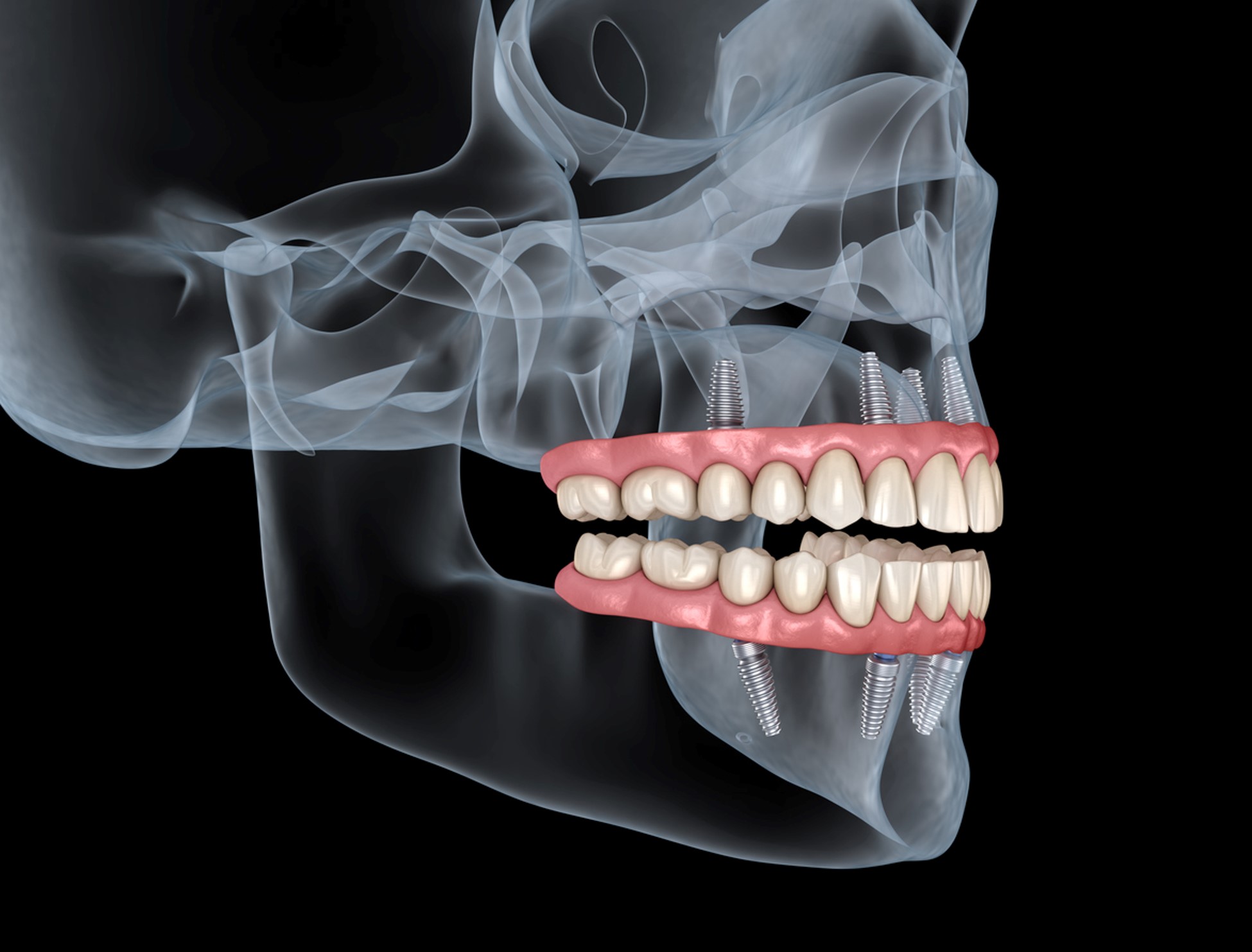
Most people researching full arch treatment read the same material repeatedly: how many implants get placed, how long healing takes, what the swelling is like. Almost nobody explains the decision that actually governs the result. The surgery in a full mouth dental implants procedure exists to serve a prosthetic plan, and that plan is settled before the first incision. The teeth a patient will live with are chosen first, and the implant positions are engineered to hold them.
There are three common endpoints for a full mouth dental implants procedure: an implant supported overdenture that snaps in and out, a fixed acrylic hybrid bridge that only a dentist removes, and a monolithic zirconia full arch prosthesis milled from a solid block. They feel different in the mouth, clean differently, cost differently, and fail in different ways. Understanding those differences before surgery separates a satisfying outcome from an expensive correction.
What Prosthetically Driven Planning Means in a Full Mouth Dental Implants Procedure
Prosthetically driven planning inverts the intuitive order. Rather than placing implants where bone is thickest and asking a laboratory to build onto whatever angles result, the restorative endpoint is designed first. The clinician establishes where the teeth need to sit for lip support, speech, and occlusion, then works backward to implant positions that carry that design. In a full mouth dental implants procedure this usually means a diagnostic tooth setup or a digital wax up comes before the surgical guide, and the guide is fabricated from that setup.
The practical consequence is that screw access holes emerge through the biting surfaces or the tongue side rather than the front of an incisor. Angled multi unit abutments correct modest divergence, but they cannot rescue an implant placed with no reference to the final teeth. Planning the prosthesis first is the most reliable way to avoid a restoration that looks compromised on delivery day.
The Three Prosthesis Types at the Center of a Full Mouth Dental Implants Procedure
The choice among the three designs is not a ranking. Each sits at a different point on a tradeoff curve of cost, cleanability, sensation, repairability, and required maintenance. A removable overdenture is the least expensive and the easiest to clean thoroughly, but it moves under function. A fixed acrylic hybrid feels closest to natural teeth for most patients and repairs easily, but its materials wear and stain. Monolithic zirconia resists wear and stain far better and is generally the most expensive, but it is unforgiving when it does fail.
A full mouth dental implants procedure can end in any of the three, and the same patient may be a reasonable candidate for two of them. The honest work of the consultation is matching the design to the person’s anatomy, hygiene habits, budget, and tolerance for follow up visits rather than defaulting to the most elaborate option available.
The Implant Supported Overdenture as an Outcome of a Full Mouth Dental Implants Procedure
An implant supported overdenture is a removable prosthesis that snaps onto attachments carried by a smaller number of implants, commonly two to four in the lower arch and four or more in the upper. The attachments are either locator style abutments seated on each implant, or a milled or cast bar splinting the implants together with clips engaging it.
The profile appeals to many patients. It comes out at the sink, so the tissue underneath and the abutments themselves can be brushed directly. It is usually the least expensive way to complete a full mouth dental implants procedure. In the upper arch the palate can often be reduced to a horseshoe or eliminated entirely once implants carry the retention, which restores taste and temperature sensation that a conventional denture blocks. A flange around the outside of the ridge restores lip and cheek support for patients who have lost significant bone height.
Attachment Wear and Recall Realities After an Overdenture Full Mouth Dental Implants Procedure
The tradeoff is movement and consumables. An overdenture is implant retained but partly tissue supported, so it settles slightly under a hard bite and pivots a little around the attachment axis. Most patients adapt quickly, but it is not the sensation of fixed teeth.
The nylon inserts inside locator housings are wear items by design. They lose retention over months to a year or two depending on how often the prosthesis is removed and how forcefully the patient chews, and they are swapped chairside in a short appointment. Bar and clip designs have the same logic in a different shape. Planning a full mouth dental implants procedure around an overdenture therefore means accepting a recall rhythm of periodic insert changes, occasional relines as the ridge remodels beneath the acrylic, and eventual replacement of the denture teeth if the patient wears them flat. None of this is failure; it is scheduled upkeep.
The Fixed Acrylic Hybrid Result of a Full Mouth Dental Implants Procedure
The fixed acrylic hybrid is the workhorse of full arch implant dentistry. It consists of denture teeth and pink acrylic processed onto a titanium or milled metal bar, screwed directly to multi unit abutments. Only the dentist removes it, by backing out the prosthetic screws at a maintenance visit. Between visits the patient treats it as teeth.
For a large share of patients this is the most comfortable endpoint of a full mouth dental implants procedure. The acrylic has some resilience, which cushions the bite in a way that harder materials do not. The pink acrylic can be contoured to replace lost ridge without a removable flange, which matters after years of bone loss. The intaglio surface sits just above the tissue with a convex, cleansable profile, and hygiene is performed with a floss threader carried under the bridge or, more practically, a water flosser tracing the arch daily.
Repair, Wear, and Staining in an Acrylic Hybrid Full Mouth Dental Implants Procedure
Acrylic and denture teeth are not permanent materials, and honest planning treats that as a known cost rather than a surprise. Denture teeth abrade over years, faster against a natural or restored opposing arch. Acrylic picks up stain from coffee, tea, and red wine, and it can chip at a thin margin or fracture around a screw access channel.
The compensating advantage is that almost all of this is fixable. A chipped tooth can be added to or replaced. Worn or discolored acrylic can be stripped and the arch re processed over the same metal bar, which preserves the expensive substructure and the verified fit. When a patient is weighing a full mouth dental implants procedure and expects to keep the same prosthesis for many years, the ability to refresh a hybrid without redoing the framework is a real economic advantage.
The Monolithic Zirconia Prosthesis in a Full Mouth Dental Implants Procedure
Monolithic zirconia takes a different approach. The entire arch, teeth and pink tissue alike, is milled from a single pre shaded or layered zirconia disc, then stained, glazed, and sintered. There is no acrylic to absorb stain, no bonded denture teeth to debond, and no metal bar, because the zirconia is the framework.
Patients who choose this endpoint for a full mouth dental implants procedure are buying wear resistance and color stability. Polished zirconia holds its surface for years and resists the staining that eventually dulls acrylic. It can be milled thinner in some regions while remaining strong, which helps when vertical space between the implant platform and the opposing teeth is limited. It is generally the most expensive of the three because of material, milling time, and the precision the fit demands. It also requires a highly accurate record of implant positions, since zirconia cannot flex to accommodate a framework that does not seat passively.
Force Transmission and Fracture Risk in a Zirconia Full Mouth Dental Implants Procedure
Zirconia is rigid, and rigidity has consequences. It transmits chewing force to the implants and the bone with very little cushioning, which is why night guards are commonly prescribed for patients who grind. That force also travels to the opposing arch, and a zirconia arch biting against natural enamel can accelerate wear on those natural teeth.
When zirconia does fail it tends to fail decisively. A crack through a milled arch is generally not repairable chairside the way a chipped acrylic tooth is, and a remake means milling a new arch. Small surface chips in the glaze or a fractured cusp can sometimes be smoothed and re polished, but structural fracture usually means starting over. Anyone considering a full mouth dental implants procedure finished in zirconia should weigh that against the material’s clear advantages, and should understand that adequate prosthesis thickness and correct implant positions are what keep the risk low.
How Implant Number Shapes a Full Mouth Dental Implants Procedure
Implant count is not a vanity number; it determines which prostheses are structurally reasonable. An All on 4 style configuration places two axial implants anteriorly and two tilted posteriorly to avoid the sinus and the mental nerve, spreading support without grafting. Four implants can carry a fixed hybrid in many mouths, particularly in the denser bone of the lower jaw.
Adding a fifth and sixth implant shortens the cantilevered segment at the back of the arch, distributes load more evenly, and creates redundancy if one implant is later lost. Six or more implants are frequently recommended when the plan calls for zirconia, when the opposing arch is a full natural dentition, or when the upper jaw’s softer bone argues for more support. A full mouth dental implants procedure built on two or three implants belongs to the overdenture category, where the tissue shares the load and the prosthesis is designed to move slightly.
Bone Volume, Ridge Loss, and Lip Support in a Full Mouth Dental Implants Procedure
How much ridge a patient has lost is one of the most underdiscussed inputs, and it often settles the design on its own. Teeth lost decades ago leave a resorbed ridge that has moved up and inward in the upper jaw and down and outward in the lower. Replacing only crowns on such a ridge produces long teeth, dark spaces, and a collapsed upper lip.
Pink prosthetic material solves this, and where that pink material sits is the question. A hybrid or zirconia arch carries replacement tissue as a fixed part of the bridge but cannot extend far into the vestibule, since material there would be impossible to clean. An overdenture flange can reach further and support the lip more completely. When a full mouth dental implants procedure is planned for a patient with substantial ridge loss and a deficient upper lip, that flange is sometimes the deciding factor in favor of a removable design.
The High Smile Line Question in a Full Mouth Dental Implants Procedure
Every fixed full arch prosthesis has a transition line where the prosthesis ends and the patient’s own tissue begins. In a patient whose lip covers the gumline, that junction never becomes an issue. In a patient with a high smile line who shows several millimeters of gum tissue when smiling broadly, the transition can become visible, and a visible seam looks artificial no matter how well the teeth are shaped.
Assessing that smile line early changes the surgical plan. The usual solution during a full mouth dental implants procedure is an alveoloplasty, meaning controlled reduction of the ridge at the time of extraction and placement, which lowers the bone and moves the transition line up under the lip while also creating the vertical space the prosthesis needs. The alternative for some patients is an overdenture, whose flange conceals the junction naturally. Photographs of an unforced, full smile taken before surgery make this call reliable.
Hygiene Access as a Daily Reality After a Full Mouth Dental Implants Procedure
Whatever the material, peri implant tissue stays healthy only when plaque is removed from around the implant necks every day. The three designs demand different habits, and matching the design to a patient’s actual routine matters more than matching it to their intentions.
An overdenture is the most forgiving. It lifts out, the abutments are brushed under direct vision, and the prosthesis is cleaned over a sink. A fixed hybrid or zirconia arch requires cleaning underneath a bridge the patient cannot remove, which realistically means a water flosser used along the full length of the arch daily, supplemented by a floss threader pulled beneath the pontics. Patients with limited dexterity, arthritis, or a history of inconsistent home care often do better with a removable design. A full mouth dental implants procedure that outruns a patient’s hygiene capacity creates inflammation, and inflammation around implants is far harder to reverse than around teeth.
Speech Adaptation Differences Following a Full Mouth Dental Implants Procedure
Speech changes after any full arch prosthesis, and the adaptation curve differs by design. Sibilant sounds depend on a narrow airflow channel between the tongue and the palatal surface of the upper front teeth, so any change in that region alters the sound of an s.
A fixed hybrid or zirconia arch is generally thinner across the palate than a denture, and most patients report clearer speech than they had with removable teeth, though the bulk needed on the tongue side to house screw channels can produce a temporary whistle or lisp that resolves as the tongue adapts. An overdenture with a reduced or open palate frees the tongue but leaves a border that some patients notice at first. Anyone completing a full mouth dental implants procedure should expect several weeks of adjustment, and should know that persistent speech problems are usually a contour issue a laboratory can correct.
The Opposing Arch and Staging a Full Mouth Dental Implants Procedure
What bites against the new arch changes the wear calculation entirely. A prosthesis opposed by a complete denture sees gentle, evenly distributed force, and acrylic teeth may last a long time. A prosthesis opposed by a full natural dentition, especially in a patient who clenches, absorbs concentrated point loads, the situation where acrylic wears fastest and zirconia’s durability earns its cost. Zirconia opposing natural enamel introduces the reverse concern, so occlusal material selection is a two arch decision.
The decision does not have to be locked before treatment starts. A staged approach lets the patient wear a screw retained provisional through the months of osseointegration, live with fixed teeth, test hygiene access and speech, and confirm tooth position and lip support before the definitive prosthesis is fabricated. Staging a full mouth dental implants procedure this way turns an abstract choice into an informed one and gives the laboratory a proven blueprint to copy.
Why Patients Choose August de Oliveira DDS for a Full Mouth Dental Implants Procedure
August de Oliveira DDS practices cosmetic and implant dentistry at 5400 Balboa Blvd #231 in Encino, CA 91316, serving patients from Encino, Sherman Oaks, Van Nuys, Tarzana, Calabasas, Woodland Hills, Studio City, and Reseda. Office hours are Monday through Thursday from 8 to 5, with Friday available by appointment.
Dr. August de Oliveira’s clinical focus is digital dentistry, and the office runs both chairside CEREC workflows and full laboratory workflows. That combination matters for full arch work, because digital records, intraoral scanning, and guided planning connect a designed prosthesis to the implant positions that carry it. Having both pathways available means the design of a full mouth dental implants procedure is not constrained by a single production method; a case is routed to chairside milling or to a laboratory depending on material and arch complexity. Patients get a plan built around the prosthesis they will live with rather than around what a single workflow can produce.
Final Thoughts on the Full Mouth Dental Implants Procedure
The surgery gets the attention, but the prosthesis is what a patient wears, cleans, chews with, and maintains. An overdenture trades a small amount of movement and a schedule of insert changes for cleanability, lip support, and lower cost. An acrylic hybrid trades wear and staining for comfort, tissue replacement, and easy repair. A monolithic zirconia arch trades cushioning and chairside repairability for durability and color stability at the highest cost. Choosing among them is the real content of a full mouth dental implants procedure, and it is a conversation about anatomy, habits, the opposing arch, and priorities rather than a ranking.
Patients in Encino and the surrounding San Fernando Valley communities who are weighing full arch options can schedule a consultation with August de Oliveira DDS at 5400 Balboa Blvd #231, Encino, CA 91316 to review their records, examine the anatomy involved, and discuss which prosthetic design fits their situation.