There is a moment in every single-visit crown appointment when patients look up from their phone and watch a small machine cut a solid ceramic block into an exact replica of their tooth. It takes about ten minutes. Most people find it more interesting than anything else that has ever happened to them in a dental chair. What they are watching is the final stage of a process that has quietly become one of the most technically sophisticated workflows in modern dentistry. This article goes underneath the convenience narrative and explains how CEREC Same-Day Dental Crowns are actually engineered: the ceramics they are cut from, the scanning and design software that shapes them, the milling and firing that finish them, and the clinical judgment required at each step. If you want to understand what makes CEREC Same-Day Dental Crowns reliable rather than simply fast, this is the explanation.
The Engineering Story Behind CEREC Same-Day Dental Crowns
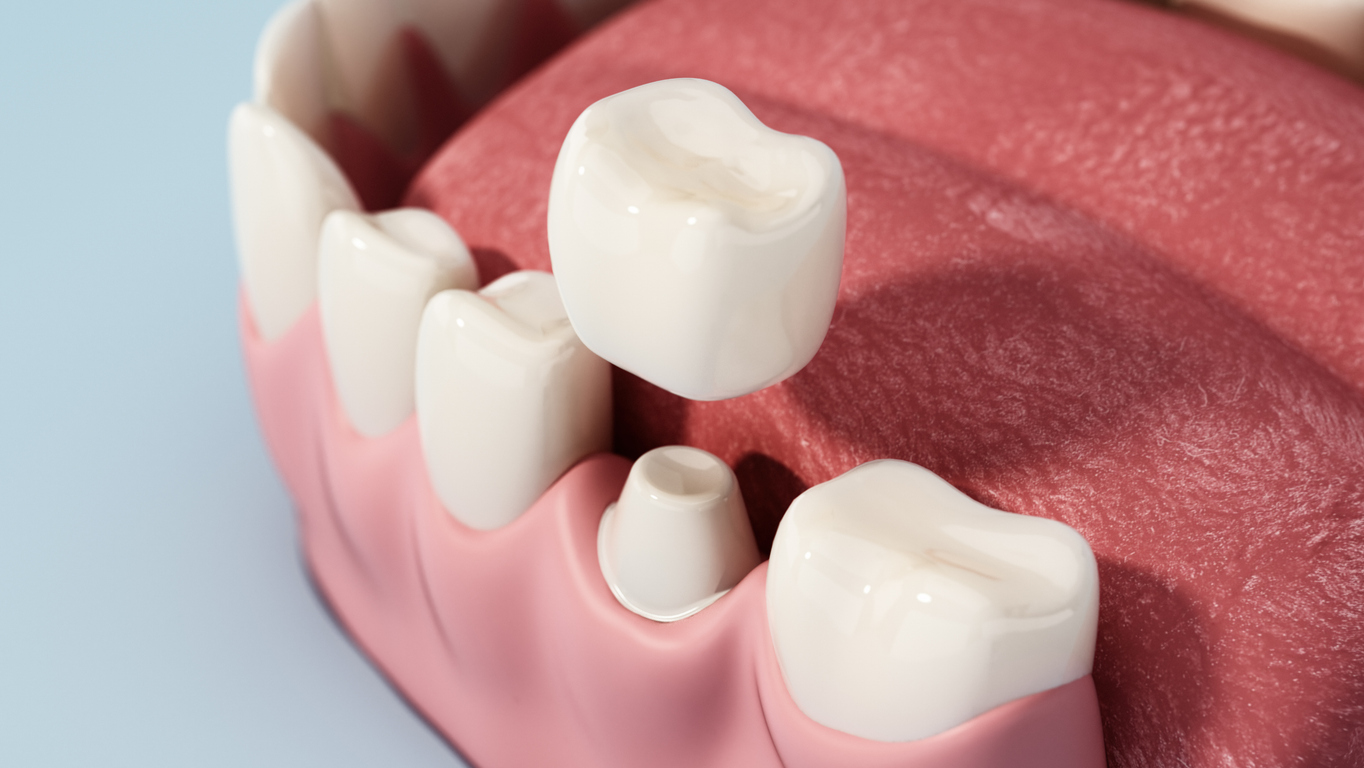
CEREC Same-Day Dental Crowns are produced through a chairside computer-aided design and computer-aided manufacturing workflow. The dentist prepares the tooth, captures a three-dimensional optical scan, designs the restoration on screen, sends that design to a milling unit in the same room, and cements the finished ceramic restoration in the same appointment. Nothing is mailed, nothing is hand-waxed, and nothing waits in a queue. The reason CEREC Same-Day Dental Crowns can be trusted despite that compressed timeline is that each step is either digital and therefore reproducible, or industrially manufactured and therefore consistent. Speed here is a byproduct of removing logistics, not of shortening clinical care, which is the single most important thing to understand about CEREC Same-Day Dental Crowns.
The Ceramic Blocks Used for CEREC Same-Day Dental Crowns
The strength of CEREC Same-Day Dental Crowns starts with the ceramic block. Dentists do not mix these materials in the office. Manufacturers produce them under tightly controlled industrial conditions. The blocks arrive as solid ingots with certified composition and density. Lithium disilicate glass ceramic offers high flexural strength and excellent light transmission. Dentists may choose zirconia for maximum fracture resistance, especially for molars in patients who grind. Hybrid ceramics combine a ceramic network with a polymer matrix. Dentists may use them when a more forgiving elastic modulus is preferable. Feldspathic porcelain remains available for highly aesthetic anterior work. The dentist matches the material to the tooth, bite, and aesthetic demand.
Why Industrially Produced Blocks Give CEREC Same-Day Dental Crowns a Consistency Advantage
Traditional laboratory ceramics often require layered buildup, firing, adjustment, and further firing. That process depends on human skill. It can also create microscopic porosity between layers, where cracks can begin. Manufacturers press and sinter CEREC Same-Day Dental Crowns blocks under controlled pressure and temperature. This creates a homogeneous solid with no internal voids. Milling then preserves that uniform internal structure throughout the restoration. This consistency is an underappreciated advantage of CEREC Same-Day Dental Crowns. Long-term survival studies of chairside ceramic restorations report results comparable to laboratory-fabricated alternatives beyond ten years of function.
Digital Scanning: The First Precision Step in CEREC Same-Day Dental Crowns
The scan establishes accuracy for CEREC Same-Day Dental Crowns. An intraoral camera captures the prepared tooth, neighboring teeth, opposing arch, and bite registration. It combines thousands of optical frames into one three-dimensional model. The dentist reviews the model at high magnification before moving forward. If a capture has a defect, the dentist can correct it in seconds. A laboratory does not need to discover the issue two weeks later. Physical impression materials can distort during setting, removal, disinfection, and shipping. Digital scans avoid those sources of cumulative dimensional error. That advantage makes a strong technical case for CEREC Same-Day Dental Crowns.
How the Design Software Shapes CEREC Same-Day Dental Crowns
After the scan, design software proposes an initial restoration from the patient’s anatomy and a tooth-morphology library. The dentist refines that proposal. Clinical expertise matters more than the technology at this stage. The dentist traces margins at the boundary between the preparation and tooth. The dentist also adjusts contact points with adjacent teeth. Next, the dentist sculpts the occlusal surface. Cusps and grooves must engage opposing teeth during closing and lateral movements. The dentist contours the emergence profile so patients can clean around the gum tissue. A trained clinician makes every decision in CEREC Same-Day Dental Crowns with the tooth’s long-term function in mind.
Inside the Milling Unit That Produces CEREC Same-Day Dental Crowns
The milling unit receives the finished design and cuts the restoration from the ceramic block. Diamond-coated burs work under constant water irrigation. Milling CEREC Same-Day Dental Crowns generally takes roughly five to twenty minutes. Timing depends on the material and the complexity of the anatomy. The machine moves along multiple axes to reproduce the digital design. It also shapes the intricate undersurface that must seat precisely on the prepared tooth. The dentist approves the same digital file that guides the cutting path. As a result, the workflow avoids translation loss between design and production. This gives CEREC Same-Day Dental Crowns an advantage over multi-stage analog fabrication.
Firing, Glazing, and Characterizing CEREC Same-Day Dental Crowns
Milling is not the last step. Depending on the material, the dentist places CEREC Same-Day Dental Crowns in a small furnace for crystallization or sintering. This process transforms the block’s chemistry and greatly increases final strength. For example, lithium disilicate is milled in a softer intermediate state. It reaches full strength after firing. Before firing, the dentist can apply surface stains and glaze. These details create subtle color variation, incisal translucency, and natural surface texture. Characterization is where the artistry of CEREC Same-Day Dental Crowns comes in. It can make the difference between an acceptable restoration and an invisible one.
Seating and Bonding CEREC Same-Day Dental Crowns
The final clinical stage strongly influences longevity. The dentist tries in the restoration and verifies its fit and contacts. The dentist also checks the bite in every direction of jaw movement. Next, the dentist isolates and treats the tooth. The dentist bonds the ceramic with an adhesive resin cement suited to that material. Bonding matters enormously with CEREC Same-Day Dental Crowns. Modern adhesive ceramics gain part of their strength from their bond to the underlying tooth. Together, they act as a unified structure. The dentist removes excess cement and polishes the margins. The patient leaves with a fully functional permanent restoration and can eat normally that day.
Who Is a Good Candidate for CEREC Same-Day Dental Crowns
CEREC Same-Day Dental Crowns are appropriate for most single-tooth situations: a tooth with a large failing filling, a fractured cusp, significant decay, a tooth that has completed root canal therapy and needs full coverage, an old crown that has failed at the margin, or a tooth needing a conservative onlay rather than a full crown. They are also well suited to patients with a strong gag reflex who struggle with impression trays, patients with limited scheduling flexibility, and patients with dental anxiety who would rather face one appointment than two. CEREC Same-Day Dental Crowns are equally valuable in emergency situations where a tooth fractures and needs definitive protection immediately.
When CEREC Same-Day Dental Crowns Are Not the Best Choice
Credibility requires acknowledging limits. CEREC Same-Day Dental Crowns are less commonly the first choice for extensive full-arch reconstructions involving many units and significant bite changes, for certain multi-unit bridges spanning long distances, for some implant-supported restorations requiring specialized components, and for the most demanding anterior cosmetic cases where a technician’s hand layering of multiple porcelain shades produces a marginally superior result next to a highly translucent natural incisor. Patients who cannot sit comfortably for an extended single appointment may also prefer a staged approach. A practice that offers both workflows will tell you honestly when CEREC Same-Day Dental Crowns are and are not the right tool.
How CEREC Same-Day Dental Crowns Preserve More Natural Tooth Structure
One of the quieter clinical benefits of CEREC Same-Day Dental Crowns is conservation. Because the restoration is bonded adhesively and designed digitally against a live model of the opposing bite, the dentist can often choose a partial-coverage onlay instead of reducing the entire tooth for a full crown. The software confirms in real time that a conservative preparation will still provide adequate ceramic thickness for strength. Every millimeter of natural enamel and dentin preserved today extends how many future treatments that tooth can tolerate over a lifetime, making the conservative approach available through CEREC Same-Day Dental Crowns a long-term health decision rather than merely a technical preference.
Caring for CEREC Same-Day Dental Crowns After Your Appointment
Maintenance is straightforward. CEREC Same-Day Dental Crowns are brushed and flossed exactly like natural teeth, with particular attention to the gumline margin where plaque accumulation could eventually cause decay in the tooth beneath. Mild sensitivity to temperature for a few days is normal and typically resolves. Patients who clench or grind should be fitted for a nightguard, since parafunctional forces are the leading cause of ceramic fracture in any crown regardless of how it was made. Avoid chewing ice, hard candy, and popcorn kernels. Keep routine examinations, because a dentist can detect early marginal breakdown around CEREC Same-Day Dental Crowns long before it becomes a problem you would notice.
Common Questions Patients Ask About CEREC Same-Day Dental Crowns
Patients regularly ask whether CEREC Same-Day Dental Crowns are weaker than laboratory crowns, and current evidence says no for the great majority of single-tooth cases. They ask whether the appointment hurts more, and it does not, though it is longer in one sitting. They ask whether insurance covers them, and coverage is typically based on the procedure code for a ceramic crown rather than the fabrication method, so benefits are usually the same. They ask how long CEREC Same-Day Dental Crowns last, and with good preparation, bonding, and home care, longevity comparable to conventional crowns is well documented. They ask whether the machine replaces the dentist, and it does not; it executes a design the dentist creates.
How CEREC Same-Day Dental Crowns Fit Into a Broader Treatment Plan
A crown is usually a signal that a tooth has already survived decay, a large restoration, a fracture, or root canal therapy. Placing CEREC Same-Day Dental Crowns without examining why the tooth failed leaves the underlying cause in place. A practice that also provides periodontal therapy, occlusal analysis, nightguards, implants, and clear aligner treatment can identify whether grinding, bite imbalance, or gum disease is driving the pattern. Integrating CEREC Same-Day Dental Crowns into that broader diagnostic context is what turns a single successful restoration into a stable long-term outcome across the entire mouth.
Why Patients Choose August de Oliveira DDS for CEREC Same-Day Dental Crowns
Patients from Encino, Sherman Oaks, Van Nuys, Tarzana, Studio City, Woodland Hills, Calabasas, and Reseda seek out August de Oliveira DDS for CEREC Same-Day Dental Crowns because the practice pairs chairside digital fabrication with deep restorative experience and full laboratory collaboration when a case warrants it. Dr. de Oliveira has built his career at the leading edge of digital dentistry, and the office is equipped for digital scanning, three-dimensional imaging, chairside milling, implant placement, and comprehensive restorative care. That range means the recommendation you receive about CEREC Same-Day Dental Crowns reflects what your tooth actually needs. The practice is located at 5400 Balboa Blvd #231 in Encino, with hours Monday through Thursday and Fridays by appointment.
Final Thoughts on CEREC Same-Day Dental Crowns
The convenience of finishing a crown in one visit is real, but it is the least interesting thing about this technology. What matters is that a digital workflow removes several stages where dimensional error historically crept in, that industrially manufactured ceramic blocks deliver a level of internal consistency hand-layered porcelain cannot guarantee, and that the dentist retains complete control over every clinical decision from margin design to final bite adjustment. CEREC Same-Day Dental Crowns are not a shortcut. They are a more direct path from diagnosis to a precisely fitted permanent restoration. If you have a cracked tooth, a failing filling, or an old crown that needs replacing, contact August de Oliveira DDS in Encino to find out whether CEREC Same-Day Dental Crowns are the right solution for your situation.